

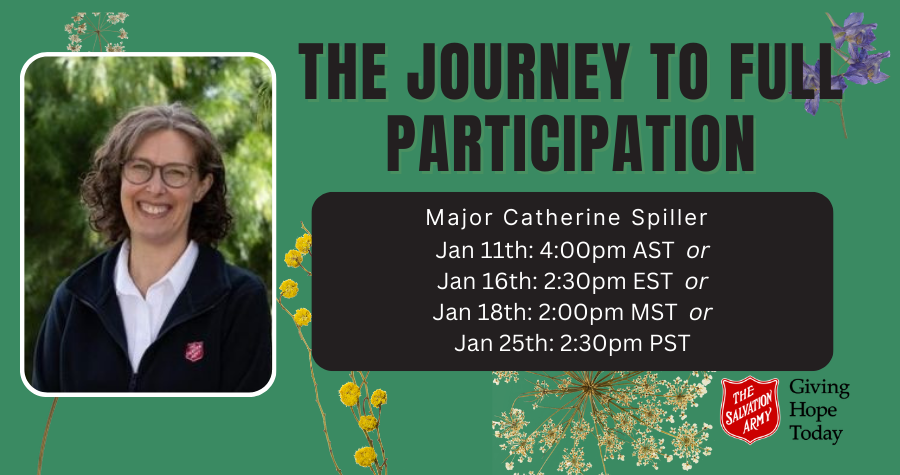
The Journey Toward Full Participation
Bio: Major Dr. Catherine Spiller, has been a Salvation Army Officer since 2002 serving in a variety of appointments in Corps and Officer Formation. Currently, she is the Coursework Coordinator for higher education at Eva Burrows College. Catherine is married to Rhys, and they have two children, Joshua and Bethany.
Quote: “The body of Christ is full of so much diversity and we are blessed and
strengthened when we create space for people to encounter Jesus and to
flourish in their faith and as people.”
Description:
Have you ever considered how to engage with people with disabilities in your corps? Come along to this webinar where I will share with you the journey that I have been on as a parent of a young man with an intellectual disability and as an Officer. We will explore together what full participation looks like and how it can be applied in your ministry setting.
OR
Have you ever wondered how to involve people with disabilities in worship? In this webinar, I will share with you the journey that I have been on as a parent of a young man with an intellectual disability and as a Corps Officer. We are also going to explore together what full participation is and what it means for your ministry.
Topics to be covered:
My story as a parent:
- Not being included or needing to join in so Josh could participate.
- The discomfort that people experience with disability (what if I say the wrong thing?)
Pivotal Moments that started me thinking:
- Catholic Church and the liturgy.
- Children’s ministry Sunday and Joshua being asked to participate – the difference that this made to Joshua
Corps Officer Observations:
- Mooroolbark Corps (2017) We are great at welcoming people with disabilities and the building is accessible.
- But I observed that the more complex someone’s disability the less likely they would have an opportunity to participate.
- A lot of what we do in worship relies on someone's ability to read.
- People with disabilities are often not on the radar when we plan worship.
Inclusion vs. Full Participation:
- What is the difference between the two?
- Why does it matter?
- Full participation reflects the metaphor used in Scripture of the body of Christ.
What did we do:
- Spent time talking to the families that are impacted by disability in the corps (the most important thing you can do).
- Worked with a small group in my corps.
- Began to look at how people were invited to participate in worship.
- Principles that emerged and how we apply them (with practical examples).
Principles of Participation:
- Listen Lots
- Practice Repetition
- Use Imagery
- Show Respect
- Recognise Anyone Can Participate
- Be Intentional
- Try Something
Challenges to Participation
- Lack of Awareness
- Lack of Time

