




When my wife and I adopted two children, a brother and sister whom we had fostered, the government issued new official birth certificates for them, placing our names as their birth parents. Our name and our entire genealogy now belong to them as much as to our biological children.
New Testament readers first meet Joseph, the father of Jesus, in Matthew’s genealogy. Because Joseph was Jesus’ legal father, this genealogy also belongs fully to Jesus. To an ancient audience, a genealogy revealed much about a person. Matthew structured his genealogy based on significant figures and events in Israel’s history. Yet, whereas most genealogies convey the significance of the individual based on their parentage (Who was Isaac? “The son of Abraham,” notes Luke 3:34), Matthew’s genealogy introduces a subtle but significant twist: each member of the genealogy derives their identity in relation to their descendants and, ultimately, in relation to Jesus (Who was Abraham? “The father of Isaac,” notes Matthew 1:2). Matthew’s unconventional approach illuminates the significance of Joseph. Who was Joseph? He was “the husband of Mary, and Mary was the mother of Jesus” (Matthew 1:16).
Whereas Matthew identifies other men in the genealogy by their offspring (not their parentage), he identifies Joseph by his wife, and Jesus by his mother. Mary linked Joseph to Jesus. Jesus was, properly speaking, the son of Joseph. Who was Joseph? What was his influence upon Jesus? What can we learn about fatherhood from his story? Matthew helps us to answer these questions. He refers to Joseph more than the other Gospels do, granting readers a unique perspective on Jesus’ human family of origin.
A HUSBAND’S LOVE
Matthew describes Joseph as “a righteous man” (Matthew 1:19 NLT) and immediately substantiates the claim by describing Joseph’s behaviour. One example of Joseph’s righteousness is his determination not “to expose [Mary] to public disgrace” (Matthew 1:19). Righteous people do not use their status to harm others. Joseph was not just labelled “righteous” or another venerable attribute; his virtue issued in deliberate choices to nurture and protect others. Before Jesus “loved [his disciples] to the end” (John 13:1), he witnessed his father love his mother.
JOSEPH’S CHOICES DURING JESUS’ YOUNG LIFE CAUSED JESUS’ NARRATIVE TO ECHO GOD’S REDEMPTIVE INVOLVEMENT IN ISRAEL’S HISTORY.—DR. ISAIAH ALLEN
Joseph’s righteousness was shaped by torah (God’s revealed scriptural instruction for Israel). Luke portrays Joseph and the holy family as devout, practising Jews (see Luke 2:21-24, 39-41). But Joseph did not just observe surface-level pronouncements about what was allowed (e.g., divorce) or prohibited (e.g., extra-marital sex). He grasped the deeper intentions of torah and its revelation of the character of God. The torah commonly expressed God’s character in formulas such as: “The Lord, the Lord, the compassionate and gracious God, slow to anger, abounding in love and faithfulness” (Exodus 34:6).
Joseph sought to be like the God he worshipped, providing an example to us, as he did to Jesus, whose own views on marriage echoed Joseph’s deliberate choice. Although the Synoptic Gospels (Matthew, Mark and Luke) repeat most of Jesus’ teaching on marriage and divorce, one passage on the topic appears only in Matthew’s account of the Sermon on the Mount (see Matthew 5:31-32). This passage indicates that marital infidelity is grounds for divorce, suggesting that Joseph followed through with his betrothal because he did not consider Mary to have been unfaithful to him (see Matthew 1:20). Jesus’ teaching may have resonated more with his formative experiences than we recognize.
NARRATIVE ECHOES
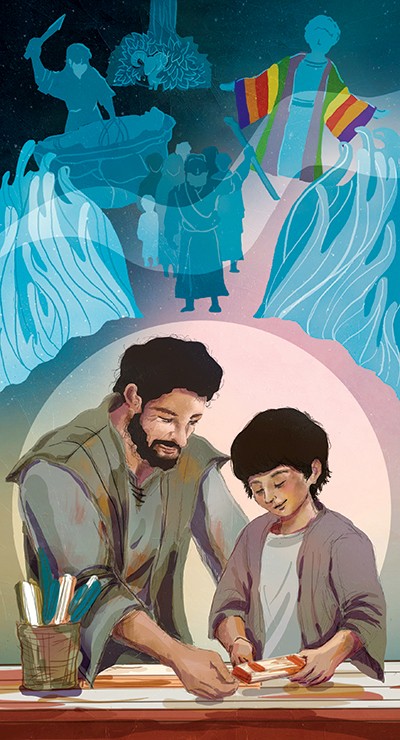 Joseph links Jesus to Israel’s story both by way of genealogy and by way of analogy. Joseph’s choices during Jesus’ young life caused Jesus’ narrative to echo God’s redemptive involvement in Israel’s history. From contending with a murderous king to sojourning in Egypt to departing Egypt with new hope, along with other poignant correlations, Matthew wants his audience to perceive how the holy family’s humble story followed the definitive contours of Israel’s history. Joseph sometimes looked like a patriarch (e.g., his namesake, Joseph) and sometimes like a prophet (e.g., Daniel). For Jews such as Matthew, perceiving events in this way validated God’s activity in the life of Christ and the church.
Joseph “did what the angel of the Lord had commanded him” (Matthew 1:24). Joseph had at least four distinct dreams in Matthew, more than any character in the New Testament, suggesting a similarity with his Old Testament namesake (see Genesis 37-50). Each time he received clear instructions in a dream, his obedience is described in similarly precise terms. Joseph named his son Jesus; he took the child and his mother and fled to Egypt; he returned to Israel and settled in Nazareth. Every time he perceived the Lord’s guidance, he willingly obeyed.
Joseph does not stray from his convictions, but he also does not act irrationally. He received revelation in dreams, but he also confirmed it by his understanding of torah and his application of reason and discernment. For instance, the specific time he departed Israel, his reluctance to go to Judea and the specific place he settled (Nazareth) were not determined by explicit revelation alone but also by his own sensibilities (see Matthew 2:13-23).
DREAMS AND VISIONS
Not everyone in a fatherly role provides a good example, leads with integrity or demonstrates spiritual sensitivity. Everything we know about Joseph, however, is positive. We know less about his story than we might like, but Joseph is one of the few biblical figures who leaves an entirely positive impression on the reader. Contrast this portrayal with figures such as Adam and Eve, Abraham and Sarah, Moses, the great King David, the prophet Elijah, or the disciples, whose faults are sometimes as prominent as their strengths.
Joseph did not merely follow the letter of torah or his own private judgment about right and wrong. He was spiritually sensitive and attentive to how God spoke to him in the very questions of his life. The revelation he received in dreams was anchored to the shape of Israel’s history, which gave Joseph reason to trust that God would watch over his family as he followed God’s guidance. Joseph’s dreams did not stand alone as isolated indicators of God’s inscrutable will. Dreams tend to be frustratingly ambiguous, but Joseph had remarkable clarity because his dreams corresponded to what he had learned about God’s providential involvement in Israel’s salvation history.
Joseph may have been a tektōn (carpenter, mason; see Matthew 13:55) in terms of his vocation, but he also resembled a prophet. In the torah, God told the Israelites, “When there is a prophet among you, I, the Lord, reveal myself to them in visions, I speak to them in dreams” (Numbers 12:6). Although Joseph is not called a “prophet,” he bears the marks of one. Peter’s first sermon at Pentecost (see Acts 2:14-21) suggests that faithful Jews would perceive ordinary people experiencing the gifts of prophecy to signal the messianic age. Quoting Joel 2:28, he proclaimed: “And afterward, I will pour out my Spirit on all people. Your sons and daughters will prophesy, your old men will dream dreams, your young men will see visions.” Like Elizabeth and Mary (see Luke 1:39-56), Joseph signalled the coming of the Messiah by participating in the spiritual power of the messianic age. Imagine the influence of being raised in a family like that.
THE FATHER OF JESUS
In closing, let me highlight three worthy practices that emerge from Scripture’s portrayal of Joseph, the father of Jesus: First, he aimed to emulate the character of God, not just to adhere to a surface-level understanding of God’s instruction. Second, he integrated knowledge from revelation with knowledge from tradition, reason and experience in his decision-making processes. And third, he trusted God’s guidance and providence as he obeyed God’s direction in his life. As I endeavour to be a good and faithful father, I find Joseph’s example inspiring.
DR. ISAIAH ALLEN is assistant professor of religion at Booth University College in Winnipeg.
lllustration: Rivonny Luchas
This story is from:





Leave a Comment