



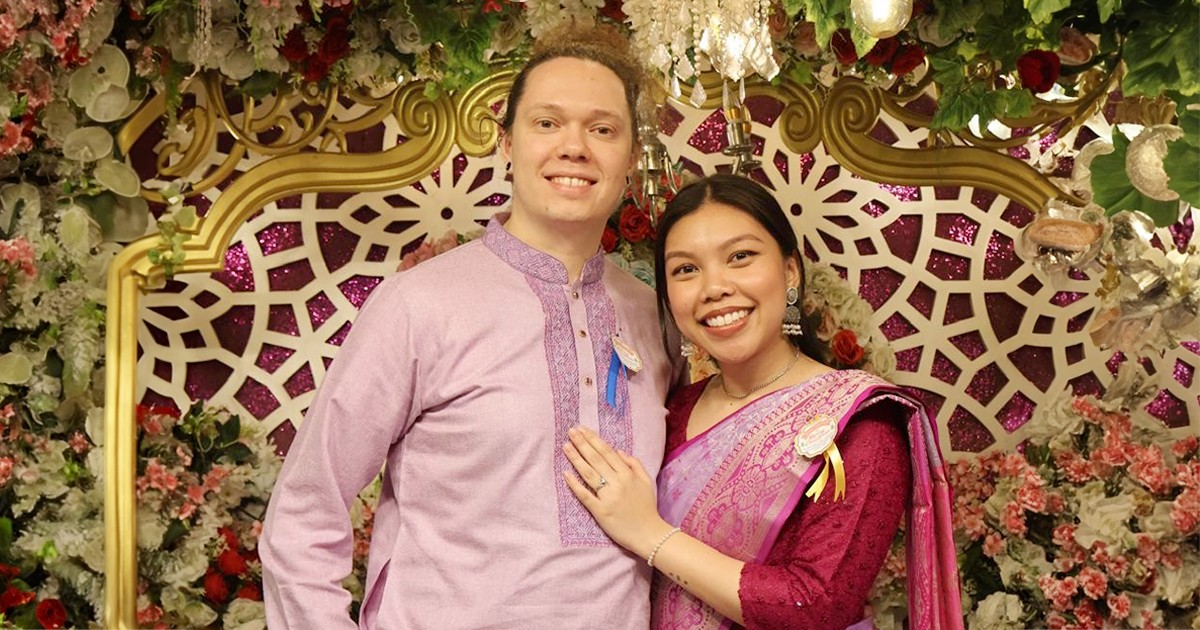
Canadian Salvationists Jahred and Jessica Warkentin continue to share their experiences and prayer requests as they serve in ministry with The Salvation Army in Bangladesh. See the end of the article for a link to past blog entries.
We all have Christmas traditions, and they often centre on family, biological or otherwise. Over our three Christmases together in Canada, my wife, Jessica, and I had developed our own Christmas rhythms: regular kettle shifts, carols by the fire, Bloorstock (the annual Christmas talent show at Bloor Central Corps, our home church in Toronto), and the Christmas Day meal with our corps; attending Jessica’s parents’ Christmas Eve service; and meals and present exchanges with both of our families.
I have always found Christmas a time of great reverence. Each year, through song and sermon, I find myself in awe of the action of God coming down to be with us in human form. In the West, this reverence is often practised through introspection. We sit with an Advent reading or message. We give a little smile when a lyric hits right during a carol. Christmas is a time of peace, which we understand as a form of inner peace. As someone who is more reserved and pensive, I enjoy this aspect of Christmas.
Unsurprisingly, Christmas looked a little different for Jessica and me this year. It was the first Christmas away from our immediate families and Toronto church community for both of us, and we were wary of what it would be like. How different would Christmas feel without our regular traditions? What moments would I have for reverence?
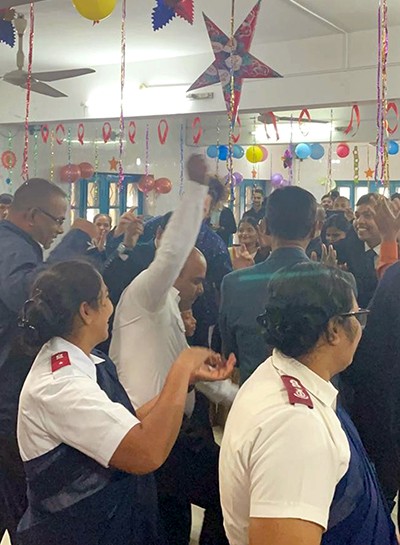
In the Bangla language, Christmas is translated as boro deen (literally “big day”) and there are many ways Bengali Christians gear up for their “big day.” Like life back in Canada, our Christmas was filled with many parties, this time with various offices and groups around the territory. But parties here look a bit different. Since Bangladesh is a predominantly Muslim country, there is little in the way of traditional, Victorian-inspired Christmas decoration (think Christmas trees with lights and garlands, stockings, wreaths, etc.). Instead, parties are decorated with balloons and general party store decor, making the celebration feel very much like a grand birthday party (which it is). This is accompanied by a large Christmas cake and singing Happy Birthday to Jesus while the kids blow out the candles and are hand-fed first bites.
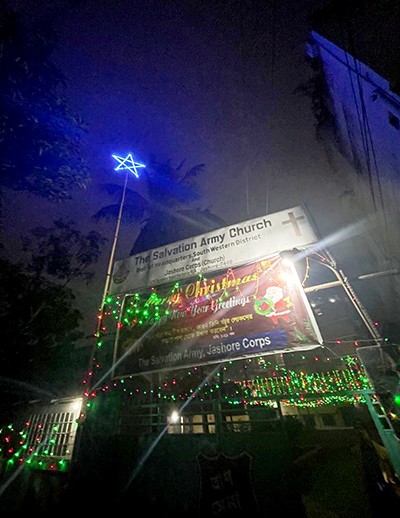
An illuminated star attached to the South-Western District headquarters / Jessore Corps
Bangladeshi celebrations have an overwhelming feeling of joy that I do not always experience at Canadian celebrations. Here, it’s not a Christmas carol unless it moves you to break it down on the dance floor. The announcement of Christ’s birth hadn’t made me feel outward, embodied joy until an elderly lady from our corps pulled me by the wrists to dance with her in the dance circle. In the West, we sing Joy to the World, but this year I asked myself, “Do we embody it?” How many of us sing carols with our hands in our pockets or with a focus on musical excellence, as opposed to embracing an ecstatic exultation?
One may think being a majority Muslim country would make Christmas dull. For more than a century, Christians in the West have been writing and complaining about the commercialization of Christmas. Here, Christmas is what you make it. What people know about Christmas is from what they see the church doing. To have a Christmas completely centred on Christ can never be dull. Christmas is the carols you can hear one village over. Christmas is the illuminated star raised on a long pole for the whole village or city to see, proclaiming and declaring this boro deen: “Emmanuel is born. God is here with us!”
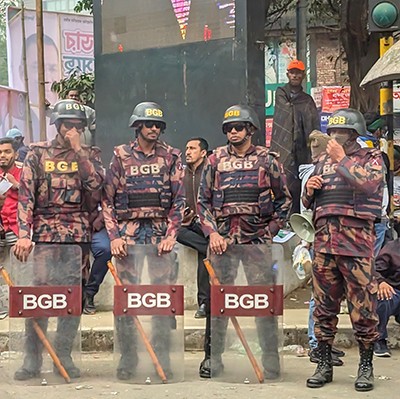
On the other hand, for most Bangladeshis, December 25 is just that: December 25 and nothing more. We felt this absence of communal recognition the most when we had to leave our Christmas Day service early to ensure we made it home before potential political unrest began as an exiled political leader returned to the country. We prayed for safety as we drove through crowds of people. And yet, we were reminded that Christ came down especially for these moments of brokenness. It was a reminder of the contrast between putting our hope in a political leader and surrendering it to the King of Kings. The Christmas story has no meaning in a perfect world, but the joy of Emmanuel is that he is here in all seasons—through introspective reverence, outward embodied joy and the chaotic unrest that surrounds us. He is here.
Read more Letters from Bangladesh here:
Videos
Jahred joins a group of carolers from a nearby church who showed up at their guesthouse:
Jahred dances at the South-Western District Christmas party:





Leave a Comment