



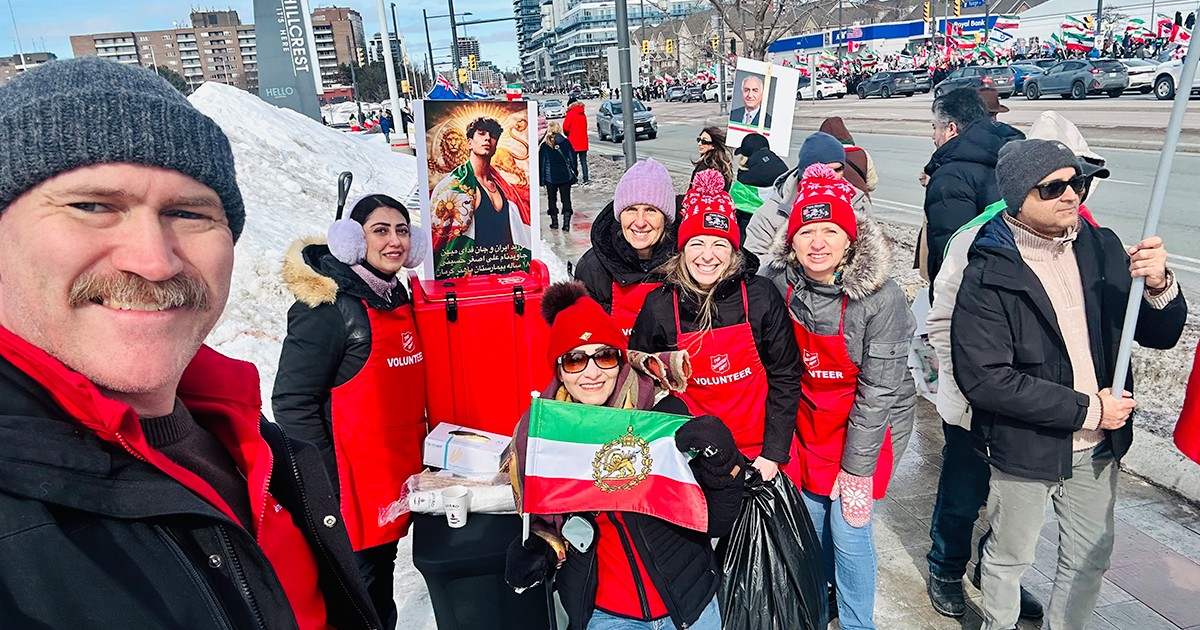
(above) Members of Richmond Hill CC share warm drinks at a local protest. "We just wanted to be present, to show up with a cuppa of love," says Major Krista Andrews, "and it was really quite a lovely experience"
In recent weeks, many of us have been watching the escalating tensions in the Middle East with heavy hearts. Yet the way we encounter these events today is very different from generations past. News no longer arrives once a day through a newspaper or an evening broadcast. It reaches us in a constant stream—videos, commentary, breaking alerts and personal posts—appearing on our phones at every hour.
At any given moment, we can watch footage from across the world: protests unfolding in real time, images of violence, voices crying out for help, commentary layered upon commentary. Alongside this flood of information comes something else: uncertainty. It is increasingly difficult to know what is reliable, what is incomplete and what may be shaped by bias or agenda. Algorithms quietly shape what we see and how often we see it, reinforcing certain narratives while filtering others from view.
In this digital landscape, the world’s conflicts arrive not only in our minds but in our bodies. The images we scroll past, the videos we watch, the stories we hear—they accumulate in ways our hearts and souls were never designed to carry. Human beings were not meant to absorb the suffering of the entire world in real time. The sheer volume of information now available to us can be overwhelming—too much for our heads to process, too much for our hearts to hold, too much for our souls to bear.
And yet behind every image and headline are real people.
For communities such as Richmond Hill, Ont., where our church serves, the events unfolding in Iran and across the Middle East are not distant realities. Richmond Hill is home to one of the largest Iranian communities outside of Iran. Many of our neighbours carry deep stories—of homeland, of hope, of grief, of longing for peace. They carry family ties, friendships, memories and deep concern for loved ones living in the midst of wild uncertainty. We live in a community shaped by many cultures, deep histories and real emotions.
When global tensions rise, and the world goes dark, the weight is felt locally—in conversations, in quiet worry and in prayers whispered for safety and peace.
Recently our church staff gathered around the table to talk about what was unfolding. We paused to listen to our Farsi-speaking pastor, Aux-Captain Elli Bagheri, who helped us understand some of the complexity and heartbreak many in the Iranian community are carrying right now. Elli was born and raised in Iran and has been leading the local Persian ministry here at Richmond Hill Community Church. Elli became a Jesus-follower in Iran and was active in ministry and leadership in the underground church in her native home. Her family fled the country after the threat of being jailed for her faith.
As we listened, we simply held space—for her, for the Iranian people and for the reality of loving two places at once. It was a sacred moment that reminded us of something important: global conflict is often carried most heavily in local hearts.
The People of Iran Are not the Headlines
When Iran appears in the news, the focus is usually on politics, governments, international tensions and posturing for control. Yet these headlines can obscure the everyday reality of ordinary people. Iran is home to roughly 92 million people—families, students, artists, grandparents and children—many of whom long for freedom, stability and the opportunity to flourish in their own homeland. Many Iranians feel caught between powerful forces, unspeakable violence and competing agendas that do not reflect the hopes they carry for their lives for a bright future.
For Iranians living abroad, this creates a painful tension. They watch the news knowing that behind every headline are real people—parents, siblings, cousins and friends whose safety and future are uncertain.
The Suffering is Deeper Than We Often See
Those who have left Iran frequently carry stories the wider world rarely hears. Many fled violence, political pressure or severe restrictions in search of a safer future. But leaving did not mean leaving everything behind.
Families remain. Homes remain. Lifetimes of memories and culture remain. When tensions escalate, communication with loved ones becomes uncertain. Information is limited. Rumours circulate. Fear grows. Many Iranians living abroad also carry a quiet form of survivor’s guilt. They are grateful for the safety they have found in countries such as Canada, yet their hearts remain deeply connected to those who do not share that same freedom.
Across Canada and around the world, Iranians have been gathering in rallies and vigils not simply to protest the current regime in power in their country, but to ensure the world does not forget the people who remain inside Iran. The voiceless who are actively being silenced through media blackouts, threats and unspoken violence. The wailing of the suffering is beyond our comprehension in the West.
There is a well-known old Persian story often told to children about a king who allowed evil to grow within his kingdom. In the story, two snakes grew from the king’s shoulders and had to be fed each day with the brains of young men. To save lives, some wise people secretly sent young men away rather than sacrificing them. Those who escaped eventually returned and helped free the people from the evil that had taken hold.
For many Iranians living outside the country, this myth not only resonates deeply but has become real life. They see themselves as those who escaped—not because they are stronger, but because they were fortunate. And because they have freedom, they feel a responsibility to speak for those who cannot, and they feel the weight of fighting for justice and freedom for their people.
What Listening Actually Looks Like
As a church community, we have been learning that one of the most faithful things we can offer right now is the ministry of listening.
Listening does not mean withdrawing from difficult realities, nor does it mean rushing to offer opinions or quick assessments of what we believe should happen. Listening means choosing to hear the stories of people. It means recognizing that trauma is not only carried in words but often in bodies—in the pauses, the tears, the trembling weight of memory.
Listening with intention requires entering conversations without an agenda, carrying instead a posture of concern and wondering. It means asking questions gently and allowing others to speak, while we resist the urge to fill the silence. It’s sitting in a place of unknowing, an unpopular position in the current world climate.
At Richmond Hill Community Church, we have learned to be present in moments of grief. Members of our Iranian community gather, bringing their fears, their stories and their hope for the future. Sometimes there are many words. Sometimes there are none. Grief, we have discovered, is a universal language. Tears are a kind of liquid communication. We do not need to speak Farsi to sit in these circles of sorrow and healing. The Holy Spirit has often been the interpreter among us.
In these spaces we are reminded that faithful presence is not measured by how much we say, but by our willingness to remain.
What the World Needs Right Now
The world is not lacking opinions. It is not lacking anger or frustration. Our public and private conversations are often full of them.
What the world needs right now is presence.
The world needs people who are grounded in the presence of Christ—people who are steady enough to listen, compassionate enough to carry grief and courageous enough to love their neighbours without agenda. As followers of Jesus, we believe we are shaped in the image of a triune God—a God who exists in relationship, love and self-giving presence. To live as Trinitarian people in the world means learning to embody that same posture.
It means welcoming the stranger. Standing with the grieving. Honouring the dignity of those who feel forgotten.
Scripture reminds us to “carry each other’s burdens” (Galatians 6:2). Sometimes that burden-bearing begins not with answers, but with attentive presence.
And we pray.
Prayer can feel small in the face of global conflict. Yet prayer is never passive. It is an act of faith that places the world back into the hands of the Prince of Peace. In our own church community, we have been using a prayer resource developed by 24-7 Prayer to guide us as we intercede for Iran and for the Iranian people who live among us here in Canada.
We pray for peace. We pray for justice. We pray for protection over families living in uncertainty. And we pray that the church would continue to be a place where neighbours are seen, heard and loved.
The events unfolding in Iran may seem far away. But for many in our neighbourhood, they are very close to home. And sometimes the most faithful response begins not with answers—but with presence.
Major Krista Andrews is the corps officer and Aux-Captain Elli Bagheri is the assistant corps officer, Persian ministries, at Richmond Hill Community Church, Ont.


Leave a Comment