



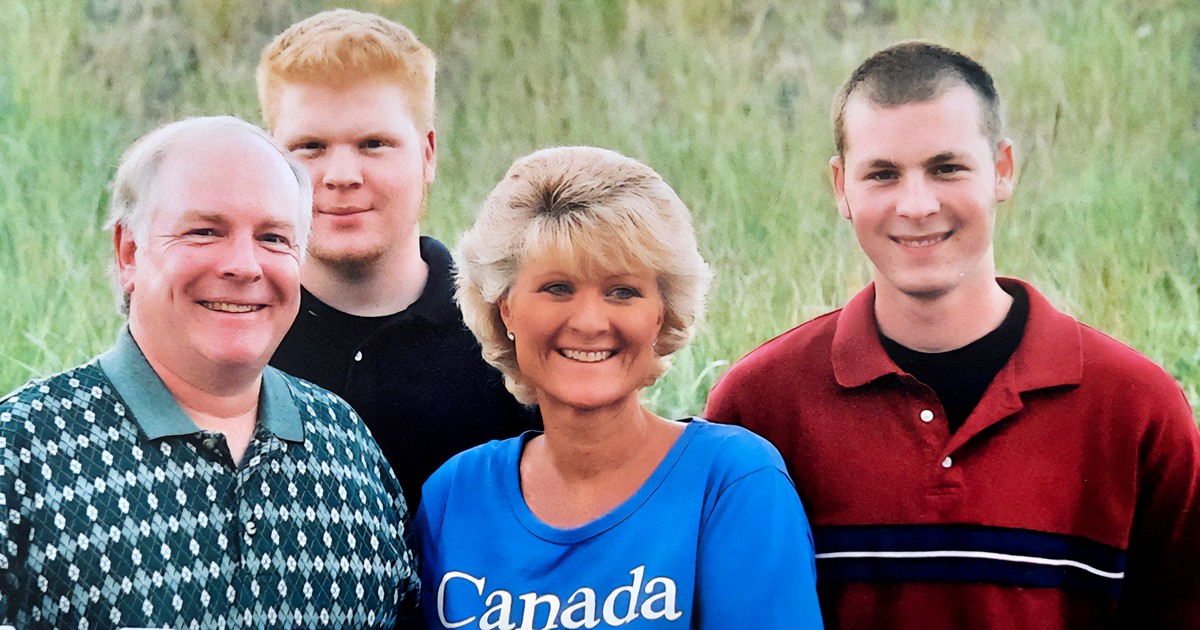
(Above) “A pain-free life would never have shown me the depths of the love of God I found in my deepest distress,” says Brenda Laidlaw, whose son, David, died after a five-year battle with cancer. From left, Allan, David, Brenda and Andrew Laidlaw
The Lord is close to the brokenhearted and saves those who are crushed in spirit.—Psalm 34:18
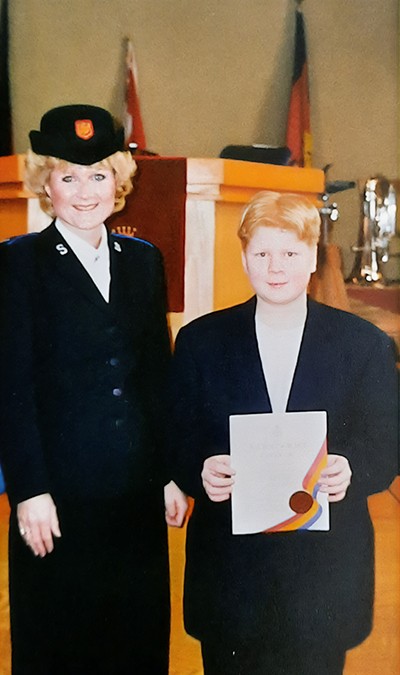
When I was a young mother of a golden-haired two-year-old son, I gave birth to a second son. He was the most beautiful, healthy, redheaded bundle of joy I could ever have dreamed of. The first time I held him in my arms I sang to him of God’s enduring love.
I had the great joy of mothering him and his brother for 34 happy years. And then the diagnosis struck like a sword piercing my heart. Cancer. Brain cancer. Incurable.
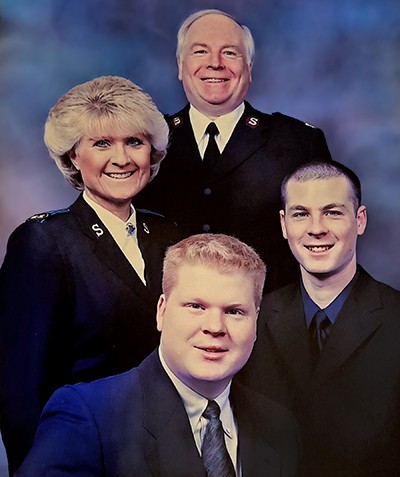
My husband and older son and I surrounded him with all the love and support and prayer we could for five precious years until finally he became bedridden. Then we nursed him at home for three poignant months before he left the earth and was birthed into eternity. That final night of his earthly life, I again held him in my arms and sang to him of God’s infinite love.
Then the grieving began—the deep, agonizing, heart-wrenching grief that comes with losing a cherished child. And I found I could not sing anymore.
Kingdom Grieving
The pain I experienced was unlike any I had ever known. It was so intense that I found there were times I could hardly breathe. I wondered if I would ever find my way out of this deep well of darkness in this lifetime. Even though I had the comfort of my faith, it did not take the pain away.
I realized that I had a choice to make. I could “medicate” my pain with busyness, distraction and psychological techniques of alleviation. I could sleep it away, eat it away or entertain it away in the attempt to escape it. Or I could expose it to the light. I could choose to feel its every nuance. I could simply choose to embrace it as mine. I could ask God to walk through it with me, holding all my tear-soaked hours. I chose what I now call kingdom grieving.
Kingdom grieving, I found, is best done within the church, and I was blessed to have church people willing to draw near to me and take time to share my sorrow. These precious people were simply willing to be sad with me. They did not try to rush me. They did not try to cheer me. They were just with me. Every person’s effort in acknowledging my loss, no matter how small, was significant and is remembered.
And I was more than blessed to have pastors—Majors Corinne and Steven Cameron—willing to embrace my sorrow and hold it gently. Pastors strong in Scripture who taught us:
- You cannot know the Word without knowing lament.
- You cannot know prayer without knowing the prayer of lament.
- You cannot know God without knowing the lament of his own heart.
Pastors full of compassion, who created a “sorrowing circle” for those of us deep and stuck in our grief, where we learned to trust God with our broken hearts. Pastors who didn’t just wait for us to come out of our sorrow, but who came into the midst of it with their own tears. Pastors who held out a Jesus to us who was familiar with sorrow because he had also wept. This Jesus. This Emmanuel. This God with us.
A Sanctuary Space
Lament was not the end of my kingdom grieving, my sacred sorrowing journey. It was only the beginning. I was still living in a self-focused understanding. There was a second step to be taken. It was the monumental step of surrender—full surrender to God of my deepest pain.
It was not easy, nor did it happen all at once. It was a gradual process that required patience and diligence. But once I started practising surrender, I found an amazing change began to take place. There started to appear “treasures of darkness” (Isaiah 45:3 ESV).
There appeared a sense of holiness in my darkness surrendered to God. It was a purifying force I had found nowhere else. There appeared a wisdom in my darkness surrendered to God. It was wisdom that far outstripped any human reasoning I had ever had.
Surrendering opened a “sanctuary space” inside me. It felt like a space of holy darkness where God’s presence shone. By surrendering my irretrievable loss, I discovered that the very darkness I experienced held God’s own self.
Such surrendering was unlike anything I had ever experienced. It required deep faith and tremendous courage and not a small amount of self-compassion. It was a practice that took many months. But what amazed me was learning that in the darkest of times there were treasures I never could have found in a pain-free life. A pain-free life would never have shown me the depths of the love of God I found in my deepest distress. My kingdom grief was becoming a gift, and I began to see that my pain was too precious to be wasted. It was an open wound that God used to fill me with the balm of his love.
Jesus said, “My soul is overwhelmed with sorrow to the point of death” (Matthew 26:38). It is only because I, too, have suffered like this, that I could even begin to identify with such a Jesus. This, too, was a great treasure of darkness. In my surrendering, God was beginning to sanctify my sorrow to me.
The Weight of Glory
My passionate prayers to God for my son’s physical healing ended abruptly the night he died. But my prayers of surrender are ongoing. My need of grace for this never ends. However, it was “bending my knee” that led me into the next step of kingdom grieving—that of healing.
I learned it is only when I accepted the fact that God had allowed suffering into my life for a purpose that I could begin to heal. Only then could I begin to move beyond simply enduring the pain. This new understanding moved me into a fresh place of beginning to heal. It was not simply a healing of the intense emotional pain, but also of the anger, guilt and all the other negative emotions that accompany severe loss. The trauma I had carried was a complicated mix of unwanted emotions, and the healing started to feel like a purification of it all. I began to glimpse the fact that maybe I was being healed by a God who still loved me.
In this healing, I began to hear God whisper to my heart, “I will be enough for you. I will fill up your emptiness with myself. Even when you think you cannot make it one more day; even when you think I cannot be trusted, I will be with you, and I will be enough.”
With such healing, God became the joy in my sorrow. He became the rest in my chaos. He became the strength in my weakness. He became enough—more than enough. And it was transformational.
Now, when I think of my physical life—the length of it and the quality of it—I no longer consider it of prime importance. I now think of it as no more than the blink of an eye compared to my eternal life. Amid my kingdom grieving, I give much thought to heaven, because someone I love is there. A piece of me is there and I yearn to be there, too. These thoughts are transforming me.
I am being transformed into seeing a greater reality than anything my five senses can experience. As much as I would love to have my son back with me, being with me as I grow old, I would not call him from heaven and the presence of God he now knows.
I am being transformed into seeing it is my soul that matters to God. He cares more for my soul than he does for any thing in my earthly life.
I am being transformed into believing that our God, who is perfectly good, allows me to suffer knowing that this is working in me a “weight of glory” beyond anything I could imagine.
I certainly cannot admit that I am fully healed or fully transformed. I gave a large part of my heart to my beautiful son when he was born, and he took it to heaven with him when he died. I will forever feel that loss. But I know, when I get to the bottom of my grief, I find God there. And he whispers to me that death is not real. Transformation, transfiguration, resurrection, eternal life … these are what’s real. And when I look to Jesus, he whispers to me: “I am in control of your life and your death. Do not be afraid. I hold the keys of death and the grave” (paraphrased from Revelation 1:17-18 NLT).
My beloved son is now waiting for me, his dad and his brother in heaven. We, who were always a strong four together, will be that once more. And then I will sing again!
Brenda Laidlaw is a senior soldier at Yorkminster Citadel in Toronto.




Thanks so much for this honest testimony to the presence of God in the darkest hours. Christian commitment is no exemption from the difficulties of life, but your experience of the presence of God validates the reality of trust in a God who walks with us through every valley.