


The doctrine of the Trinity did not emerge from a quiet library. It was hammered out in the heat of early church controversy, as Christian communities wrestled with the question that everything depended on: who, exactly, is Jesus? The Gospels and the letters of Paul testified that Jesus bore the full weight of divine authority—forgiving sins, raising the dead, receiving worship—yet the earliest believers remained committed monotheists shaped by Israel’s Shema: “The Lord our God, the Lord is one” (Deuteronomy 6:4).
The church’s answer came through centuries of debate, culminating in the Council of Nicea (AD 325) and the Council of Constantinople (AD 381). These gatherings produced the Nicene Creed, affirming that Father, Son and Holy Spirit are co-equal and co-eternal—one God in three persons, undivided in essence. The Salvation Army’s third doctrine stands squarely in this historic tradition. The phrase “undivided in essence and co-equal in power and glory” echoes the language won through those early councils, rejecting both the heresy that collapsed the three persons into one (Modalism) and the heresy that made the Son a lesser being than the Father (Arianism). This doctrine is a gift from the whole church across time, and it shapes everything about who we are and how we live.
GOD WITHIN HIMSELF IS COMMUNITY
The trinitarian conviction carries immediate and profound implications for how Salvationists understand themselves and their life together. Our own Handbook of Doctrine states it plainly: “God is a communion, a community of being, whose three persons share in intimate fellowship with one another.” God is never solitary. Before a single creature existed, the Father, Son and Holy Spirit were bound together in mutual love and self-giving.
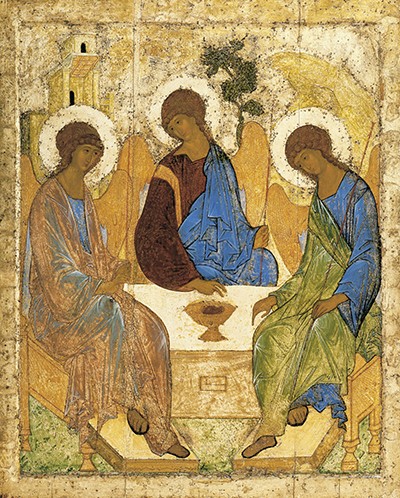
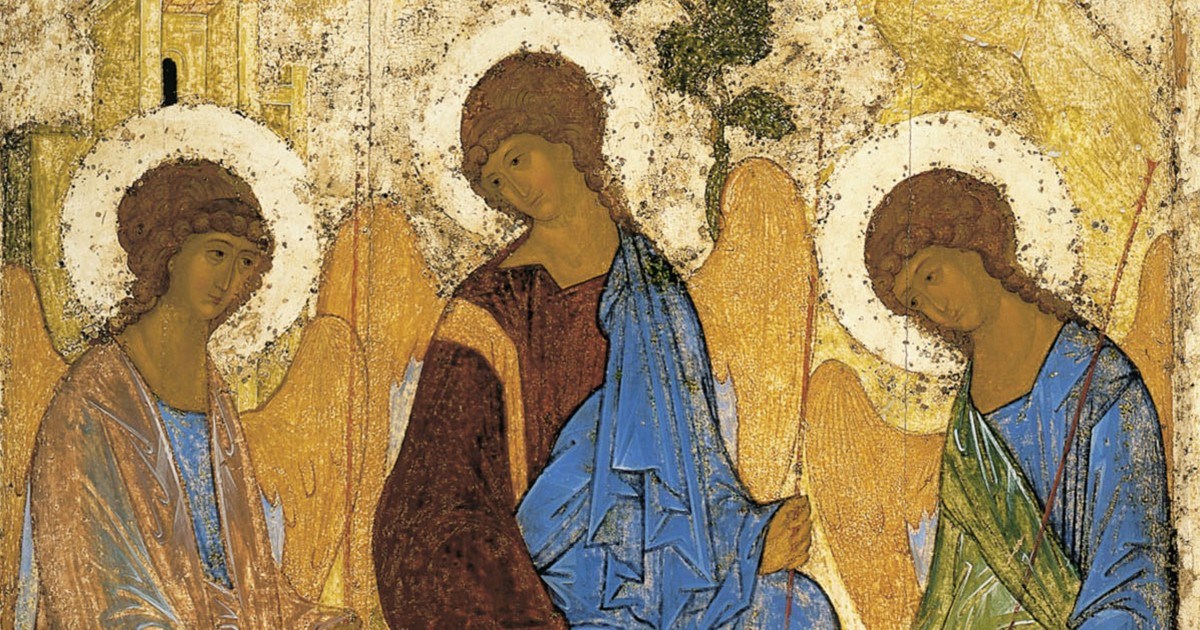
depicts the three angels who visited Abraham
at the Oak of Mamre. Also called The Hospitality of Abraham,
it invites us to take a place at the table
Theologian Stanley Grenz, in his book Theology for the Community of God, puts this with striking clarity: “The Father loves the Son; the Son reciprocates that love; and this love between the Father and the Son is the Holy Spirit … As the Spirit of that eternal relationship he is both fully deity and person.” The Trinity is, at its heart, a relationship, and that relationship constitutes the very nature of God. As Grenz continues, “The essence of God is love. Consequently, love stands as the ideal and standard for human life as well.”
This is the ground beneath the feet of every Salvationist. Scripture tells us that humanity is made in the image of this triune God (see Genesis 1:26-27). Because God is inherently communal, the human beings who bear his image are inherently communal, too. We reach our fullness only in relationship, with God and with one another. Isolation and individualism are, in the end, a contradiction of who we were made to be.
COMMUNITY AS VOCATION
In this light, the corps becomes more than a venue for religious activity for Salvationists. It is a place of formation—a community where we learn, week by week, to reflect the triune life of God. Major Ray Harris captures this well in his book Convictions Matter: “We learn to participate in the love of God by active involvement within our congregational life.” The quality of our fellowship is, on this reading, a theological statement.
The Salvation Army, at least in our territory, has long embraced the role of the “love feast” as central to our understanding of sacramental living. Our official stance on the sacraments is that we don’t just observe two or three or seven, but invite Jesus Christ to suppers, celebrations, weddings, funerals, commissionings—and everything else in between. All of these have a communal aspect to them, and that is not a coincidence.
By living out our trinitarian doctrine, we find ourselves in community with one another by design, building one another up and deepening our individual and collective spiritual vision. When a corps is marked by genuine welcome, honest accountability and shared mission, it becomes a living sign of the God it worships. This is the true practical wisdom that comes from our third doctrine. God has never been alone. And, in light of that truth, neither should we.
LIEUTENANT ZACH MARSHALL is the corps officer at The Salvation Army Faith and Hope Corps, Marystown, N.L.
Image: Wikimedia Commons
This story is from:


Thanks for sharing this exposition of the doctrine of the trinity and its implications for Salvationists! Yes, love is not a generic quality or a universal value. Christian love is grounded in the particulars of our understanding of God's own being and in the story of Jesus Christ. I hope many Sallies are encouraged by this reading.