


On September 11, 2001, two hijacked jetliners slammed into the World Trade Center’s Twin Towers in New York City, bringing both buildings down in a horrific mass of twisted girders, dust and rubble. Along with the hijack and destruction of Flight 93 and Flight 77, which crashed into the Pentagon, the attacks killed 2,977 people and thousands more were injured, with consequences that are still being felt to this day. It remains the deadliest terrorist attack in history.
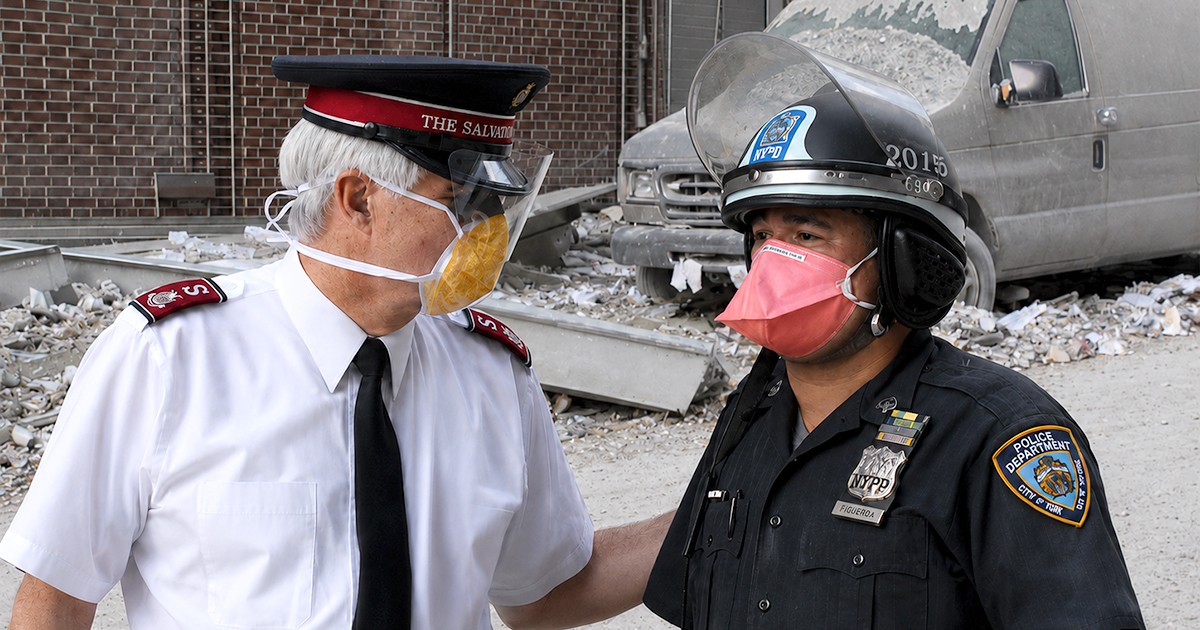
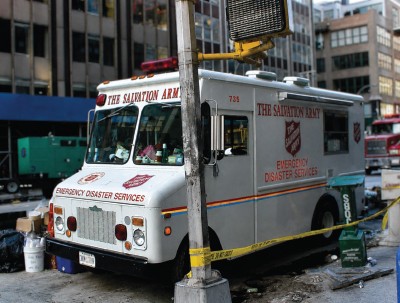
The Salvation Army was the first relief agency to respond, arriving 45 minutes after the attacks. By the time recovery efforts wrapped up nine months later, more than 7,000 Salvation Army pastors and staff and more than 32,000 volunteers had served at Ground Zero, not to mention in places as far afield as Gander, N.L.
Among those were then Colonels William and Marilyn Francis, who were serving in New York City at that time. Later promoted to the rank of commissioner, they served as the territorial leaders for Canada and Bermuda from 2007-2011.
It was business as usual that Tuesday morning. As Salvation Army chief secretary for the U.S.A. Eastern Territory, then Colonel William Francis was in a board meeting with the rest of his staff when his secretary knocked at the door to the boardroom to interrupt them, which was unusual in itself.
“We’ve just heard that a plane hit the World Trade Center,” she told those at the meeting.
“Well, of course, we thought that was tragic,” recalls Commissioner William, “but we were thinking of a light plane—that had happened before. But when we heard the announcement that a second plane had hit, we realized the enormity of it all.”
A MEMO FROM ON HIGH
That morning, Salvation Army personnel from the greater New York area descended on the scene, joined during the night by an Army detachment from the Philadelphia area.
The next morning, Commissioner William and the staff, including the territorial commander, Commissioner Joe Noland, went to Ground Zero itself.
“It was just unbelievable,” Commissioner William says. “It’s hard to put into words. What I most remember was the terrible smell. We walked down to the site and prayed with the rescue workers. We stayed there the whole day, trying to be a comfort.”
Everyone was stunned by the sheer scope of the disaster.
“You couldn’t say much because no one could believe it.”
Commissioner William walked by a firefighter who was sitting off to the side after coming out of Ground Zero.
“He looked at me and said, ‘Oh, Salvation Army! Can you help me take my boots off?’ ”
“I said, ‘Of course.’ I pulled his boots off and arranged for clean socks.
“These experiences you just never forget because you’re face-to-face with what life is all about—what’s important and what’s not important in life.”
When Commissioner William arrived home that night, his wife, Commissioner Marilyn, almost didn’t recognize him.
“I was waiting at home in prayer,” she says, “when I heard the garage door open. He was covered with ash from the top of his head to his boots.”
In one hand, he held a memo from Tower One that had fallen 107 storeys. In the other hand, he held a desk lamp that had lodged in a tree.
“See this?” the distraught pastor told his wife. “The administrative assistant had just typed this up.”
“He was in a stupor,” says Commissioner Marilyn. “All I could do was take his boots off and clean him up while I prayed for him.”
The next day, the couple made the journey back to Ground Zero.
HOPE RESTORED
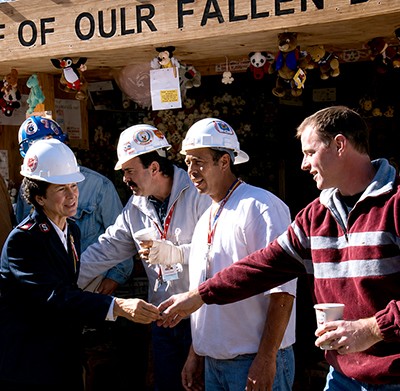
In the days that followed, they continued to serve at Ground Zero, joined by detachments from as far away as Connecticut, Rhode Island, New Jersey, Pennsylvania and Canada.
Commissioner Marilyn and her staff descended into Ground Zero.
“Under the tents were doctors and nurses and more blood than I’d ever seen in my life,” she says. “I was standing there while they were bringing body parts in. That’s what shocked me. Often, a Salvation Army pastor would go in and pray over the remains.”
As Commissioner Marilyn stood outside, one nurse ran up to her. She was a petite woman, covered in blood.
“She looked up at me and said, ‘Salvation Army, will there ever be any hope again?’ ”
Commissioner Marilyn wrapped her arms around her and replied, “Our hope is in Jesus Christ.”
“God was working through us; working through everyone who loves Him.” COMMISSIONER WILLIAM FRANCIS
“GOD IS STILL IN CONTROL”
Those memories will stay with the Francises forever. But the horror of the event strengthened their faith.
“Why was one person spared and not the other?” Commissioner Marilyn asks.
“God knew exactly. He knows exactly when our time is up.
“I learned that day that I just want to become more like Jesus. I want to act like Jesus. I want to talk like Jesus. I want to love like Jesus. Every single human I meet. And I’ll never apologize for the tears.”
“The catastrophic events of 9/11 strengthened our faith, as I know it did for all those who served there,” testifies Commissioner William. “Walking through the streets of Lower Manhattan, we met suffering humanity face to face. Our hearts were breaking, but in the midst of it all, we experienced an inexpressible heavenly peace. We came to understand that God was there all the time. God was working through us; working through everyone who loves Him.”
For Commissioner William, the events of 9/11 remain a transcendent mystery.
“We did not receive, nor could we provide, answers. We stand firm in the truth that where we cannot trace God’s hand, we must always trust and hold tight to His hand. But one thing is for sure—in and through the tragedy of 9/11, we witnessed God’s mighty work as The Salvation Army laboured in His love at Ground Zero.”
PHOTOS: COURTESY OF COMMISSIONERS WILLIAM AND MARILYN FRANCIS
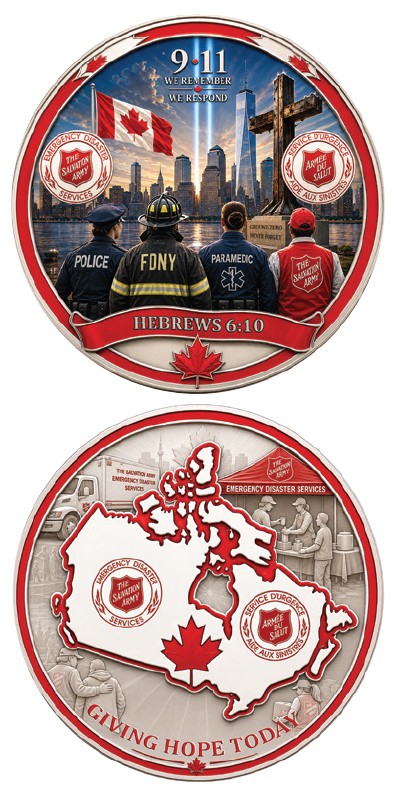 9/11 Challenge Coins
To commemorate the 25th anniversary of 9/11, The Salvation Army in Canada and Bermuda has produced 1,500 special challenge coins, which will be given out to those who responded to the tragedy.
The coin will honour the courage of first responders, emergency disaster services (EDS) volunteers, and the many acts of practical care and spiritual support offered in the days and months after the attack. EDS will work through this year to ensure that those who served will receive a coin as a lasting reminder of their faithful service, the lives impacted and the sacred privilege of standing with others in a time of profound loss, courage and hope.
“It’s a humble token of appreciation for all that these people did 25 years ago,” says Dan Millar, assistant territorial EDS director.
This story is from:



Dear Friends,
Thank you for your post on 9/11 memories. In particular Comm. William’s comments. I used them as part of my message in a vespers service on 9/11.
A couple of weeks after 9/11, I was deployed to ground zero with other officers and volunteers from the PENDEL (Philadelphia,PA) Division and it was personnel from Canada who followed us. It was an incredible ministry that TSA provided that will not be forgotten.
Thank you again for this post.
Yours truly,
Terry Shaffer, Major