

People sometimes call Port Hardy, B.C., “the end of the road.” It sits at the northernmost point of Vancouver Island, in the Regional District of Mount Waddington—home to approximately 11,000 people and seven surrounding First Nations communities.
Michael Winter, executive director of The Salvation Army’s Mount Waddington Community Ministries Centre of Hope, has a hard time with that framing.
“Where is home? It’s where your two feet are,” he says. “Doesn’t matter where that is. This is home for seven reserves, surrounding reserves and it’s home for this community.”
Not the end of the road. Home.
That distinction matters. The Centre of Hope was never built around endings but around belonging. Open 365 days a year, it provides food, shelter, showers, laundry, clothing vouchers, food hampers, free tax filing, weekly legal-aid access and mental-health referrals—and something harder to put on a list: a place where people are seen, known and prayed for by name.
“It’s not just about providing services,” Michael says. “It’s about how we interact with and relate to people, because these are human lives—not just a shelter bed or a meal.”
“It’s not just about providing services. It’s about how we interact with and relate to people, because these are human lives—not just a shelter bed or a meal.” MICHAEL WINTER
“It’s Never Too Late”
Kwakwala is the language of the Kwakwaka’wakw peoples of this region—a living language, spoken and sung in ceremony and in community. At the heart of what the centre does every day is something that word carries beautifully: a gathering place.
“In First Nation culture, having a gathering place—a place where people meet and look eye to eye with each other and have a place where they can hang their hat up and call home—that was the purpose of it,” Michael explains. “There’s the physical warmth, but there’s also the emotional warmth.”
That warmth is not accidental. It is the result of a team that shows up every day rooted in something deeper. Catherine Franklin, the centre’s operations manager, has her own story of loss, recovery and finding purpose again. She knows what it is to need a place like this.
“I pray for them every night,” she says. “I pray for this place. I tell them my story to try to give them hope that it’s never too late.”
Open Doors
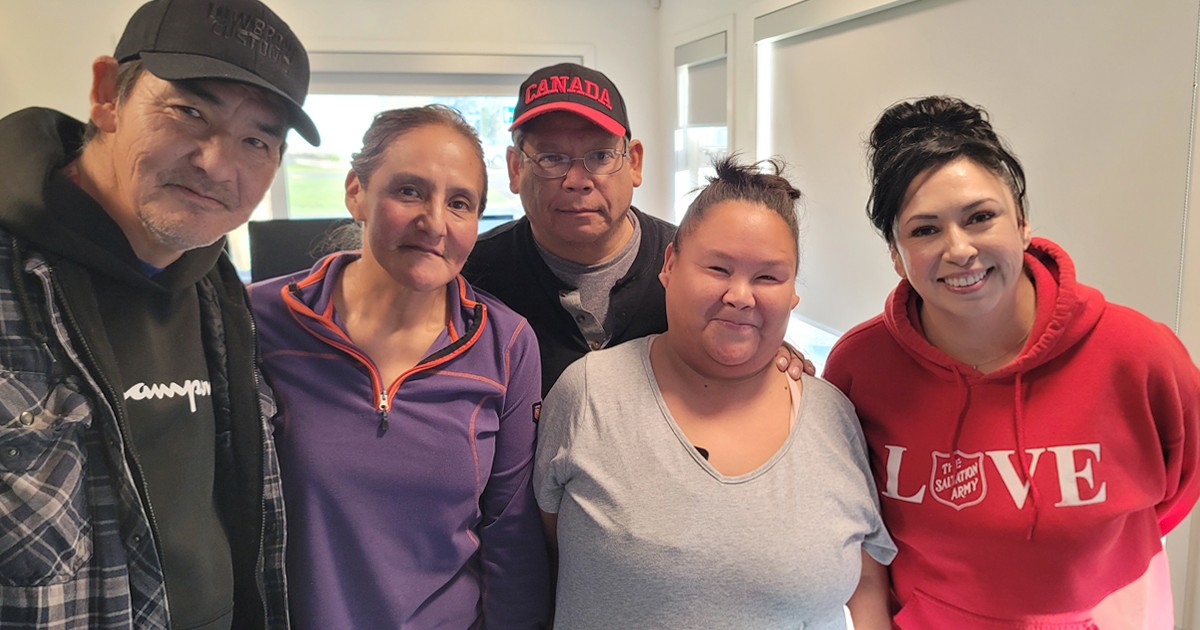
Mary Janssen was born and raised in Port Hardy. She has been coming to the centre since it opened in 2020.
“It means a lot to me,” she says. “It’s a nice place. It gives me something to do.”
When she doesn’t have anything to do at home, she comes in to help—clearing tables, washing dishes, being part of the rhythm of the place. After losing her oldest son, she found herself in one of the darkest seasons of her life. Grief pulled her toward addiction, and for a time, she lost her footing.
Today she is days away from detox, with treatment to follow.
“It’ll be a good thing for me,” she says quietly.
On Sundays, Mary comes to church with her boyfriend. It is one of the things she holds on to. And she knows that Michael is praying for her—something she carries with her through the week.
“Michael’s always been good. He’s always been a nice guy.”
In a community carrying this much weight, being known by name—being prayed for by name—is what hope actually looks like. It is what The Salvation Army has always believed: that the love of Jesus Christ does not wait at the door. It opens it.


Leave a Comment