



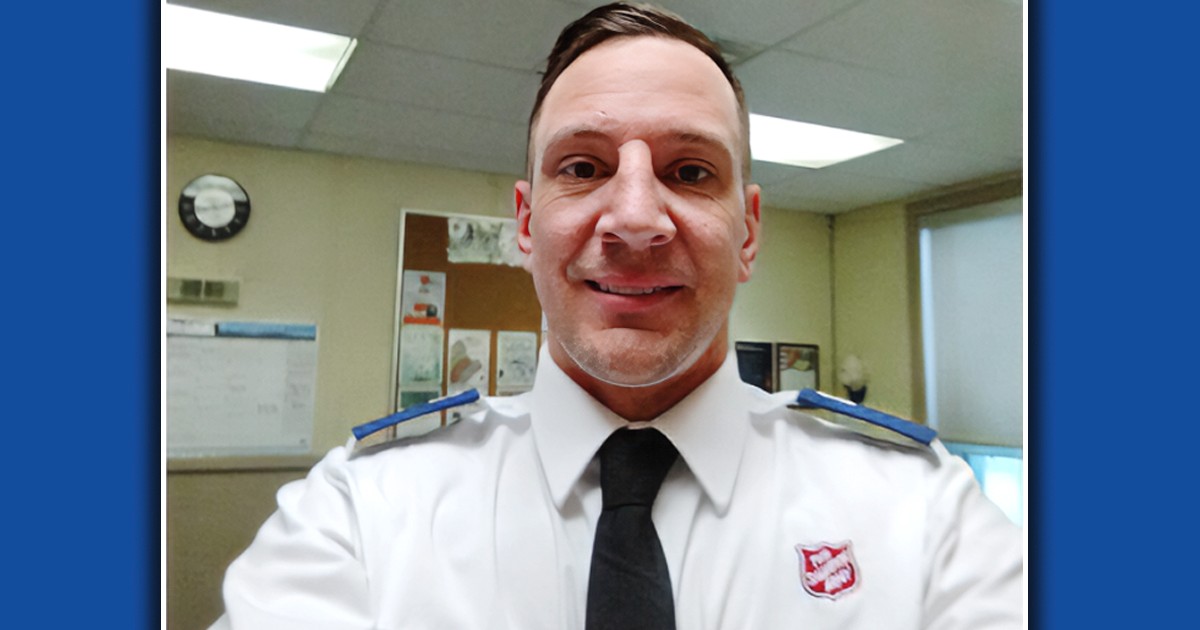
For Ian Powell, having a relationship with Christ has been the best thing in his life—but it wasn’t always that way.
Powell spent years living on the streets and battling addiction. He felt hopeless for the future and knew rock bottom all too well. But God intervened, placing people and signs in his path that led him closer to redemption and recovery.
Now living a life of sobriety and faith, Powell is a community ministries worker at The Salvation Army’s Crossroads Community Church in Edmonton where he works with others as they navigate the same recovery journey.
Needing Hope
Growing up, Powell experienced trauma that felt difficult to cope with. As a teenager, he became his own legal guardian, and it wasn’t long until he began couch surfing and turning to drugs. “I was already using drugs as a teen,” he says. “And then I started to sell drugs to make money so that I could buy more.”
The addiction carried into his adult life. In 2008, he moved from Ontario to Alberta to try to escape his addiction and bad habits, and he worked in the oil field. During this time, Powell had two children. Court and custody battles took a toll, and the addictions began to spiral out of control. “At that point, I was a functioning addict and alcoholic,” he says.
“A lot of my time in Alberta was spent trying to make ends meet, while also trying to be a part of my children’s lives,” he adds. “It was extremely difficult to navigate the court systems, and having my kids always at arm’s reach was hard. It got really bad.”
In the years that followed, Powell had two more children with another woman, but it was a rocky relationship. They tried to be a family, but addictions continued to wreak havoc. They couldn’t provide the life they hoped for their kids.
Powell visited Ontario to assist with his grandmother’s estate after her passing, and while he was there, his youngest children were apprehended from their mother, who also struggled with addiction, and they were put into the foster system.
“When I found out about that, I returned to Edmonton to try to get my kids back into my care and navigate the child services and court systems, and I fell on hard times,” he says. “My addiction was out of control. I started using meth and things went downhill fast.”
For five years, Powell tried to get his children back, but recovery seemed out of reach.
“I spent the better part of five years living on the street, addicted,” he says. “But no matter how bad things got, The Salvation Army was always there.”
Road to Recovery
“I remember one specific time I was considering suicide. I didn’t know what to do or who to call. I didn’t know if there was a life worth living at that point,” Powell admits.
He began cold-calling numbers and got a hold of a man named John at The Salvation Army’s Edmonton Centre of Hope. John spent two hours on the phone with him and helped arrange for Powell to get some food and a place to stay that night.
After being arrested for selling narcotics, Powell had the opportunity to participate in the Edmonton Drug Treatment Court Program, a court-ordered diversion program for individuals who struggle with substance abuse and have had criminal offences. He was able to prove that the only reason he sold drugs was because he was an addict, and that he needed help. So, he entered the program, which included detox and treatment.
“In the beginning stages, I was having a rough time. I wasn’t quite ready. The first treatment centre didn’t work out, and I got sent back to jail for about five weeks,” he says. “Then I was released into the Salvation Army stabilization program. Working with some of those folks, I started to see hope again.”
Powell’s case manager recommended that he attend a treatment centre in Drumheller, Alta., called Grace House. Their slogan is “Helping Men Recover With Dignity,” and it became a turning point in his recovery journey.
“It’s about helping us walk with grace and rewrite the rules we learned as men that become toxic later in life—the pushing down of feelings and emotions—so that we can be more compassionate and empathetic, openly share feelings and create a brotherhood,” explains Powell. “Men are struggling today. We have a strong loneliness epidemic, and suicide rates are climbing. I’m so grateful for that treatment centre because they work to fix that issue in society.”
The Salvation Army’s Drumheller Community Church was just down the road from the treatment centre, and Powell spent most of his spare time there. He volunteered as much as he could, helping with food pantries and the Christmas toy distribution program. He began attending services and participating in Celebrate Recovery, a Christ-centred recovery program offered at the church.
“Every time I hit rock bottom, The Salvation Army was there,” says Powell. “Every time I wanted to better myself, The Salvation Army was there.”
Beacon of Hope
“I was so angry for many years,” Powell admits. “I blamed every single problem on God and everybody else.”
It wasn’t until after being arrested and spending time in jail that he began to accept God as part of his life. “When I first got to jail, they gave me a little Bible. On the front was a cross, and at the top it said ‘Redemption.’ That spoke to me,” he says.
Powell recalls a chaplain in jail who once asked him if he prayed. Powell told him, “The only time I pray is when I have nothing left—when I’ve hit rock bottom and when everything is going horribly.”
The chaplain responded, “Ian, God wants to hear from you. If the only time you talk to God is when you’re in trouble, when your back is against the wall and there’s no way out, then your back will stay against the wall until you listen to him.”
That response stuck with Powell, and once he opened the door for God to be in his life and asked for a relationship with him, he started to feel God’s presence more each day.
In recovery, Powell learned to take responsibility for his feelings of anger and blame, and instead of turning away from God, he leaned in.
Every time I hit rock bottom, The Salvation Army was there. Every time I wanted to better myself, The Salvation Army was there. IAN POWELL
Since then, his faith has grown exponentially. After graduating from his treatment program, he moved back to Edmonton and began attending Crossroads Community Church where he was enrolled as an adherent, and soon after he became a senior soldier. He has attended men’s camps at Pine Lake Camp, Alta., chaperoned teen camps, and has preached on occasion.
“Through The Salvation Army, I got to start seeing the good part of the world. That Red Shield truly was a beacon,” he says. “Coming to The Salvation Army allowed me to see Christ for who he is.”
In God’s Time
For Powell, The Salvation Army always felt like a safe place and somewhere he could go for help without judgment. “Even hearing all the really hard parts of my story, they never treated me differently or looked at me like I was damaged,” he says. “They just met me where I was and helped foster the change that I needed.”
Today, he models his life by the Salvation Army quote, “Saved to Serve.” In his current role as a community ministries worker, Powell gets to be that same source of support for somebody else.
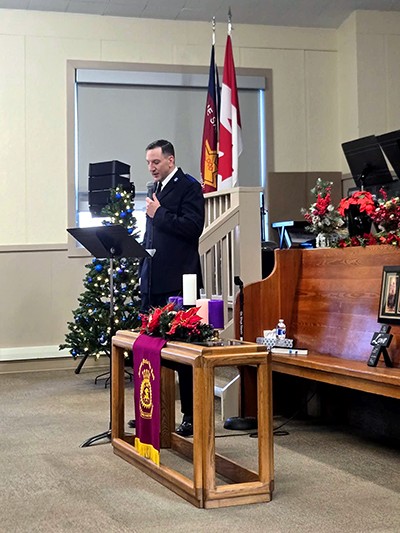
At the church, he runs a Christ-based recovery group that follows the AA 12-step program while showing how those steps interact with the Bible. On Tuesdays, he alternates leading Bible studies. “Being in a leadership role after coming to Christ myself is what really showed me the calling on my life,” says Powell.
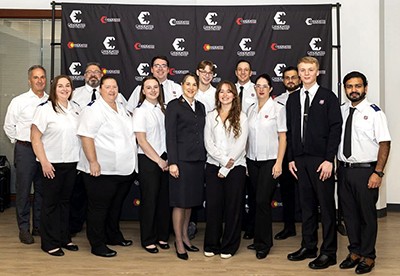
With a background in the trades as a structural welder and pipefitter, Powell wanted to go back to what he knows. But the more he prays, the more he feels the call to stay where he is at The Salvation Army. In October 2025, he attended the Explore Your Call weekend and hopes to take the steps to becoming an officer.
“I’m not sure what my timeline is, but it’s all in God’s time,” he says. “I’ve been rebuilding the things I burned down during my addiction, and God has been paving the way toward officership for me.”
Saved to Serve
Over the past four years, Powell has gone from living on the street with no prospects or future, looking at significant jail time, to today having his own home, a GED, and a growing relationship with his children.
“Where I am today is truly amazing, and I couldn’t be more grateful,” says Powell. “It’s a new life. It truly is.
“My worst days today are still far better than my best days in addiction,” he says. “All of this became possible because of God. God’s been driving the bus the whole way. I just had to stop taking the wheel away from him.”


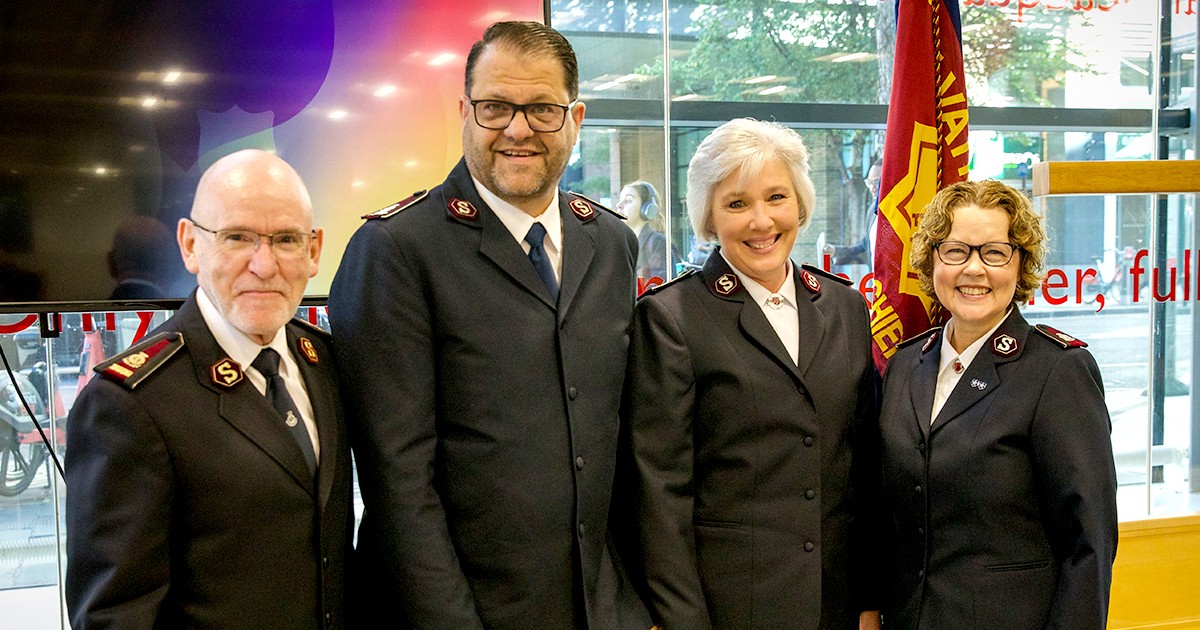


Ian, your testimony blessed my heart and I'm sure that it blessed others as well. Continue to wait upon the Lord as far as officership goes. It could be that you are already right where He needs you! I will be praying for you (and the others in the picture) that God would guide and direct you all, in this matter. God Bless you, Ian! ... Lynn :)