


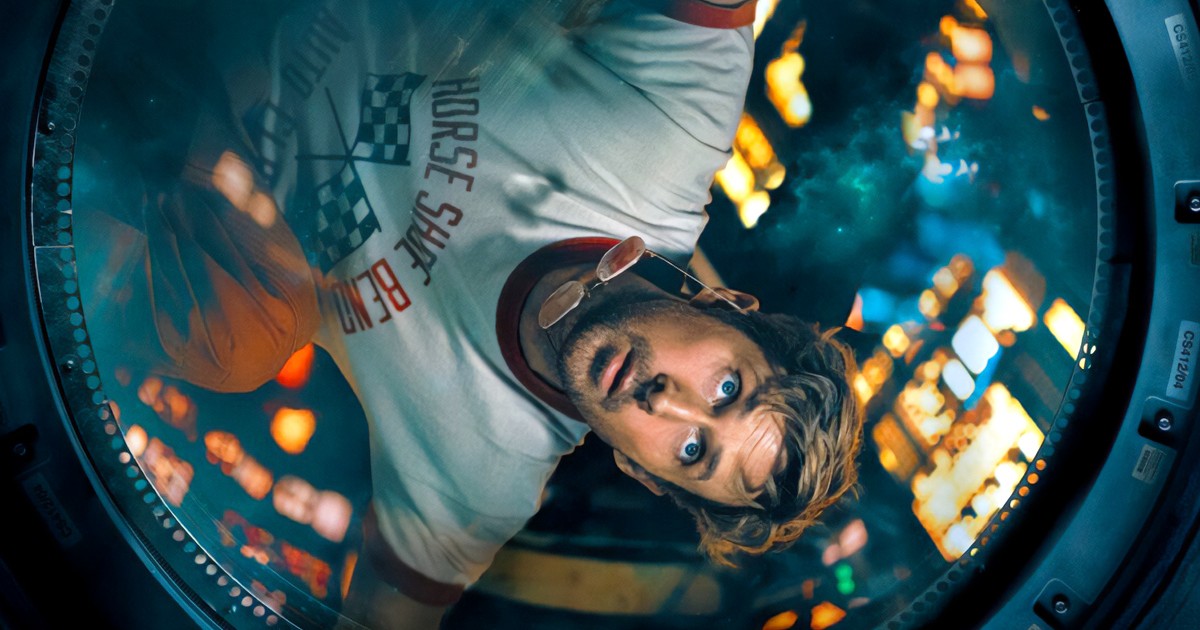
Christians have a lot to say about Project Hail Mary, a wildly successful science-fiction film based on Andy Weir’s book by the same name about Dr. Ryland Grace (Ryan Gosling), a scientist who must sacrifice himself to save the planet from tiny organisms called Astrophage. Some compare Grace’s sacrifice to save humanity to that of Frodo Baggins in The Lord of the Rings; some remark on its refreshing wholesomeness; and some are desperate to make the movie fit their theological outlook. We love a Christ figure, after all.
I can see why many Christian publications dwell on the movie as a meaningful look at sacrifice. As an added bonus, the story’s title offers a double meaning that refers both to a last-chance effort and a staple of the Catholic rosary that asks Mary, Jesus’ mother, who is “full of grace” to “pray for us sinners,” and those in the know have made much of the pun that sees the story’s eponymous spacecraft empty of all but Dr. Grace (ba dum tss).
In literary scholarship, we might consider Grace’s trajectory an example of Joseph Campbell’s “monomyth,” also known as the “hero’s journey.” It charts a protagonist’s call to action, their initial refusal of the call, their relenting, and the process of their “crossing the threshold” into a new way of seeing the world and themselves in it. This structure is perhaps most recognizable in J.R.R. Tolkien’s The Hobbit and The Lord of the Rings, and it’s often used to explain Christ figures and stories of sacrifice.
However, instead of discussing the value of Grace’s sacrifice or the details of his hero’s journey, I want to talk about the nature of sacrifice the story presents and why we need to think critically about it.
An expert in molecular biology, Grace is plucked from high school teacher obscurity by European Space Agency administrator and person least likely to be voted class clown, Eva Stratt (Sandra Hüller), when he discovers that Astrophage reproduce by consuming radiation from the sun. Their dietary preference means the earth is facing rapid cooling and soon, mass extinction, unless those involved with Project Hail Mary can find a way to stop them.
When the science officer chosen for the mission is killed just before launch, Stratt coolly chooses Grace to replace him and sends him on the one-way trip to space against his will by knocking him out and putting him aboard the Hail Mary.
When Grace wakes up, he doesn’t know who he is, much less where he is and how he got there. He discovers his dead crewmates and slowly comes to terms with his situation, which is helped when he meets a rock-like entity he creatively dubs “Rocky” along the way.
But, while Grace grows and faces his own mortality in space, none of it was his choice. In fact, when Stratt asks him to serve, he unequivocally refuses, which is why she resorts to violence.
We like to think of sacrifice as something noble and Christlike—something one chooses to do even if it’s hard because it’s right. But what does it mean to offer up an unwilling scapegoat? Can we think of sacrifice as Christlike if the one to be sacrificed has to be knocked out and carried to his “cross”? Or is that simply kidnapping?
I’ve been mulling over Grace’s sacrifice amid his lack of consent for a while now, especially as it relates to our own context.
As a work of fiction, Project Hail Mary blames microorganisms for earth’s destruction, and it highlights international co-operation for gathering the best and brightest to save the world.
In reality, the blame for our planet’s destruction lies with petroleum-guzzling plastic-producing conglomerates, government corruption and billionaires. It is the result of hoarding, not pooling, our wealth and resources, and those of us in positions of privilege are complicit through our votes, our banking and, perhaps most of all, our silence. We don’t see directly how our votes to lower taxes on the wealthy affect the poor or how our commitment to petroleum products affects those losing their homes to warming oceans and rising coastlines. We don’t want to know how our investment portfolios fund genocide and war on the other side of the globe. But they do, and we leave the most vulnerable to deal with the fallout against their will while seeking our own comfort.
Project Hail Mary reminds me that we task people with saving us without their consent all the time. While Grace’s sacrifice might seem loosely Christ-adjacent and is framed as a good thing, we need to be critical of clinging to the beauty and nobility of sacrifice while ignoring our complicity in whatever requires it in the first place.
Dr. Mandy Elliott is an assistant professor of English and film studies at Booth University College in Winnipeg.



Thanks for this thoughtful critique that complicates a too-easy assessment of the sacrifices people make to preserve the lifestyles of those who never asked permission or who ignored protest (like Dr. Stratt).
Within the movie, there is another subtle and yet instrumental sacrifice, a life consciously given to save a strange and possibly unworthy friend. That this sacrifice was made by one who was alien defies the normal profile of the hero protagonist. Grace would have never accomplished his mission without Rocky.
I found this aspect of the movie, the relationship between these unlikely friends, to be beautiful.