




I was a stranger and you welcomed me.—Matthew 25:35 (NRSVUE)
Hospitality is central to Christian faith and Salvation Army mission. The streets surrounding the Weetamah Corps in Winnipeg may not look hospitable, but I’ve learned about hospitality walking them with retired Major Lois Dueck and the street chat “family.” Following Jesus’ example, we demonstrate and experience hospitality for the gospel. We often find ourselves in other people’s homes and haunts, on the receiving end of their hospitality. Major Dueck wears a hand-written sign: “HUGS, CHATS, PRAYERS.” We open our arms to receive hugs, our ears to listen during chats and our hearts when our street kin request prayers. In other words, we just use what God gave us when we were born. Even people who are unwelcome in the homes of their own relatives and barely welcome in shelters find welcome, just as they are—happiness and heartache. (Read more about Major Dueck’s street chat ministry here.)
“Welcome!” is the most beautiful word in any language. It’s the gospel in one word. Jesus is the most hospitable person who ever lived. The one who said, “Come to me” (Matthew 11:28), is also the one who knocks on the door and wishes to enter (see Revelation 3:20). Many gospel stories feature Jesus as a guest who often took the rights of a host and frequently gave unconventional advice about hospitality (see Matthew 9:10; 22:4; Luke 11:37; 14:1, 12; John 2:2; 12:2). He likened the kingdom of God to a banquet. He hosted meals for multitudes in the wilderness (see Mark 6:34-44; 8:1-9). When Jesus wanted to welcome Zacchaeus into Abraham’s family, he made him a host (see Luke 19). Echoing Mary’s commendable act (see John 12), Jesus washed his disciples’ feet (see John 13), an essential act of hospitality. He later said that his Father welcomed his followers into his home (see John 14). Countless examples correlate the gospel with hospitality.
WHAT IS HOSPITALITY?
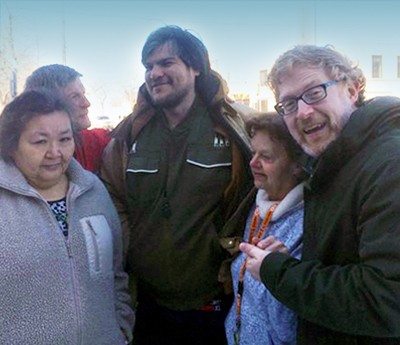
extend hospitality on the streets of Winnipeg
(Photo: Courtesy of Isaiah Allen)
Hospitality is opening our lives to others without pretence. It entails personal involvement. We open our homes, spaces and personal presence to others just as they are, just as we are. We do not wait for a special occasion or extraordinary explanation to open our door to the stranger. Remember Jesus’ words: “I was a stranger and you welcomed me” (Matthew 25:35 NRSVUE). The stranger’s claims on our generosity are God’s claims upon us (see Leviticus 19:33-34).
Hospitality means making people feel welcome around you however they show up. This is why Christians reject speech and action aimed at making others feel unwelcome and celebrate and support actions that honour people’s dignity. Criticism, grief and resistance are appropriate Christian responses to society’s failures to welcome the stranger.
The Apostle Paul instructed the Roman Christians to “pursue hospitality” (philoxenia, which literally means loving strangers) and to “bless those who persecute you” (Romans 12:13-14). This pairing is the signature of Christian virtue: indiscriminate kindness, even love toward enemies (see Matthew 5:43- 48). Aimee Patterson, a Christian ethics consultant at The Salvation Army’s Ethics Centre in Winnipeg, highlights the long tradition of hospitality in the Christian faith in “Hosts and Guests,” the sixth chapter of her book Suffering Well and Suffering With. She writes, “Hospitality is more than an industry. It is a virtue.”
We derive words like hotel and hospital from the Latin term hospes. Patterson points out that hospes can mean someone on either the giving or receiving end of hospitality. This dual meaning allows the roles to shift in practice. She points out that hospitality is about welcoming and serving the vulnerable, but that the guest often brings good things to the host.
Treating a stranger as an honoured guest scrambles the categories of status and power—a defining mark of Jesus’ kingdom (see Matthew 20:26). Patterson explains, “The practice of Christian hospitality produces a kind of fluid relationship between [hosts and guests] … Both parties share in vulnerability and power.”
WHAT DISTINGUISHES CHRISTIAN HOSPITALITY?
The term hospitality is used in many contexts, so what sets Christian hospitality apart? Let’s consider some analogies. The “hospitality industry” is, at best, a mere imitation of true welcome. Serving friends our finest food from our finest dishes is more properly called “entertainment,” not hospitality. Sales and customer service use the language and customs of hospitality, but for personal and corporate gain.
Hospitals began as voluntary places of welcome and compassion for the sick and dying, who could offer nothing in return. But modern hospitals sometimes commodify care and alienate people. Shelters should be places of hospitality, but can become unwelcoming—places people tolerate living, rather than places of refuge and healing. We must regularly check our hearts and our actions. True hospitality is not sustained by perpetual motion. It requires regular evaluation and adjustment.
Governments welcome immigrants for various reasons. Accepting refugees and granting asylum can be virtuous, but it can also be done to score political points. Since immigration boosts a nation’s economy, borders may open for mostly economic reasons. That’s not hospitality; it’s expedience. Whatever benefit the stranger stands to gain is used as leverage. When citizens question the net gain, borders close.
CRITICISM, GRIEF AND RESISTANCE ARE APPROPRIATE CHRISTIAN RESPONSES TO SOCIETY’S FAILURES TO WELCOME THE STRANGER.
These analogies might resemble hospitality at a surface level, but they do not share its soul. Christian hospitality is not a consumer product or service. It is not strategic or calculating. Just as the gospel is good news for all people (see Luke 2:10), so Christian hospitality extends to others irrespective of real or potential gain. Genuine hospitality is shown for two main reasons: the host's love and the guest's dignity. This is the soul of Christian hospitality.
Jesus told his first disciples that hospitality was pivotal to spreading the gospel (see Mark 6:7-13). Through the hospitality shown to faithful gospel witnesses, the church made inroads across the globe. Ordinary people became instrumental to God’s purpose. The Book of Acts describes the early church sharing everything and eating in each other’s homes (see Acts 2:41-47; 4:31-37). It may sound utopian, but hospitality was necessary to survival. It still is. Where persecution persists, Christians provide refuge and hope.
WORLD AT YOUR DOOR
Hospitality has always been intrinsic to Christian faith, but especially so in current times. No longer do we need to travel far to encounter the stranger. The present global village in which we live brings people to our neighbourhoods and doorsteps that previous generations of missionaries would have sacrificed much to reach, while Christians from abroad nurture revival in secularized nations. God is at work in the migration of peoples.
Without hospitality, we lose the experience of transformation and exchange between hosts and guests, and we miss a key manifestation of the kingdom of God—namely, the disruption of power and status differentials in a kingdom where “the first shall be last” (Mark 9:35). Remember the gospel: While we were strangers, Christ opened his arms for us and brought us near (see Romans 5:6-11; Ephesians 2). We get to enact the gospel every day when we welcome the stranger.
Salvationists like to serve and show up with provisions, but to heed Jesus’ command, we must learn to both give and accept hospitality. Jesus commanded his disciples to receive hospitality just as much as to show it. Although we live in a world where a culture of hospitality has degraded into a culture of consumerism, we should not dismiss the call. Rather, we should look for ways in our present culture to say “Yes!” to people’s invitations and to extend our own “Welcome!” To my knowledge, Jesus never turned down an invitation and offered many.
The most hospitable person who ever lived had no home, no shelter to offer. His personal presence was the safest place anyone could be. Even now, the hurting and harassed take refuge in Christ. As Christ’s representatives in this world, we are to serve this role. That’s hospitality.
DR. ISAIAH ALLEN is assistant professor of religion at Booth University College in Winnipeg.
Ilustration: gmast3r/iStock via Getty Images Plus
This story is from:




Leave a Comment