


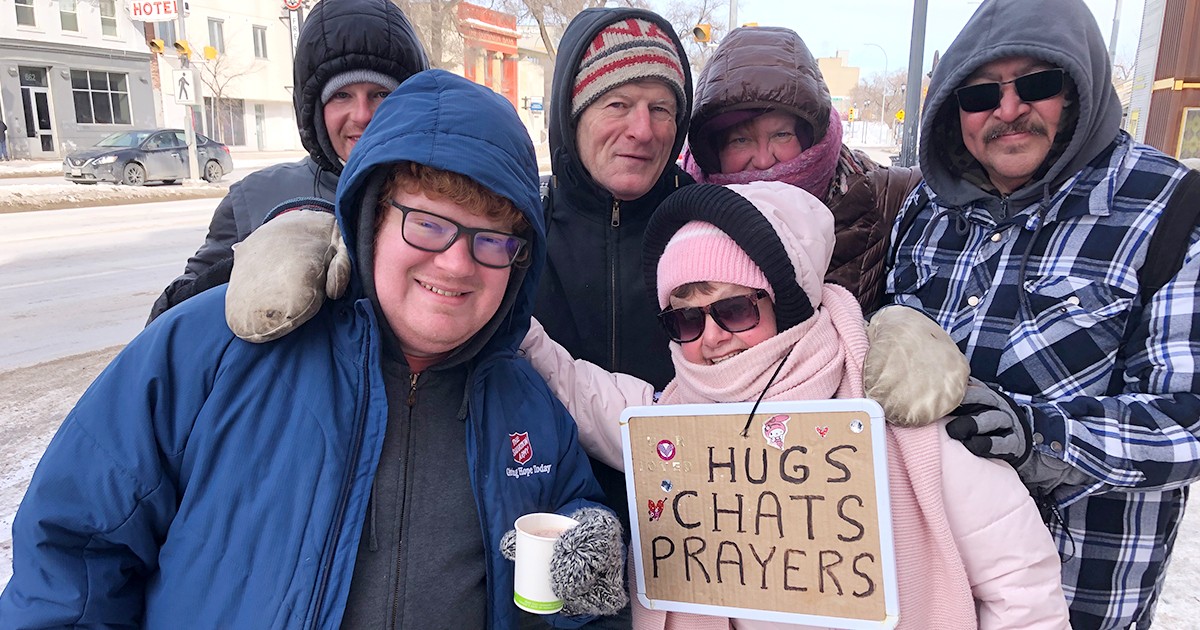
Every Saturday morning, retired Salvation Army officer Major Lois Dueck meets a small team of people at Weetamah Corps in Winnipeg’s North End. It’s a place of deep poverty, divided from the rest of the city by railway tracks, where addiction, mental illness and inadequate housing are part of life. But the team isn’t there to hand out food or lead an open-air service. They don’t take anything with them as they walk the streets, except for the hand-made sign Major Dueck wears around her neck that reads “HUGS, CHATS, PRAYERS.”
“There are more than enough shelters and food programs,” says Major Dueck. “What we are doing is getting to know people on the streets and gathering them into our family—the way they are. We’re not trying to fix them. Only God can do that.
“It’s not a charity. It’s not another agency. They are used to agencies. Most of them have had a traumatic childhood, so what’s missing in their lives is a family. Psalm 68 tells us that God is a father to the fatherless and sets the lonely in families— not in agencies, but in families. That requires us to become a family to them.”
She calls it God’s church on the street.
WITH, NOT FOR
The vision for this street church goes back to the early years of Major Dueck’s officership, when she spent five years in Ukraine. In 1993, soon after independence from the Soviet Union, the country was struggling economically and hostile to Christian faith. There were no social services available, and The Salvation Army was treated with suspicion.
“We had no office. We had no building for church,” she remembers. “What do you do when you don’t have anything? You start with people. I had to learn the Russian language, and the only way to do that is by getting to know people.
“We started to meet in parking lots, moving from place to place from one day to the next when the military police told us to leave. Everything had to happen on the streets.”
Slowly, as she built relationships, a community started to form—not a program to meet the needs of people experiencing hardship, but a church made up of them. During her time in Ukraine, five people who had experienced homelessness or struggled with addiction became Salvation Army officers.
“We’re used to doing things for people, and there I had to build something with them,” she says. “This concept, of building a church with them, not for them, was life changing for me.”
GATHERING
In Winnipeg, Major Dueck is building relationships with people in the same way—by walking the streets.
“We gather them into our family,” she says. “And to do that, we have to learn the language of people who are on the streets, who are struggling with addiction. And the only way to do that is to go out. We go out Saturday after Saturday. We don’t preach—we just listen and accept them.”
“WHEN YOU HUG SOMEBODY ... YOU CAN FEEL THE SPIRIT OF JESUS DRAWING NEAR TO THEM. YOU CAN JUST FEEL THE HEALING BEGINNING.”—MAJOR LOIS DUECK
What she hears is the language of despair.
Rejection. No family. No backup person in their life. Shame. Chaos. Lack of physical touch. Loneliness. Darkness. Not belonging. No home,” she says.
Anyone is welcome to join the team that sets out along Logan Avenue toward Main Street, but there’s a core group of about six people who come each week. There’s Terri, who was experiencing homelessness when she first met Major Dueck; Kurt, who attends The Salvation Army; Joe, who grew up on the streets; Barnabas and Johann; and Isaiah Allen, a professor at Booth University College (read his reflections on hospitality here).
It’s noisy and chaotic, with open drug use, people passed out on the street, others yelling, ambulance sirens, needles and garbage everywhere.
“Nobody will meet my eyes. Everybody has their heads down,” says Major Dueck.
But a change often takes place when she offers a hug.
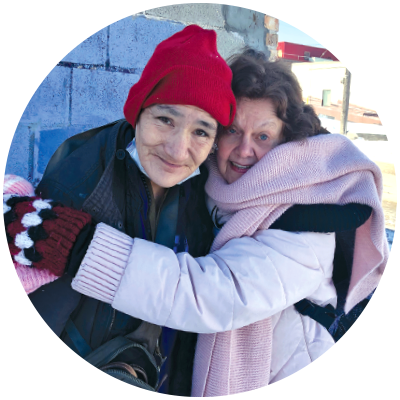
“It’s absolutely astonishing, when you hug somebody, how you can feel the spirit of Jesus drawing near to them. You can just feel the healing beginning,” she says. “Sometimes people hold onto us for 15 or 20 minutes. I’ve seen people come out of their drug psychosis and into their right mind when I’ve hugged them.”
And with the hugs, they listen, without an agenda.
“Our motive isn’t to win them for Christ—although our burning desire is that they will find him—it’s to love them exactly as they are,” she says. “People can’t hear you until you hear them.”
Often, after a hug and a chat, they are open to prayer. Major Dueck has found that many are real believers, who know their dependence on God. They ask for prayer for practical things, like finding a place to stay, for their fellow companions on the streets, for estranged children. And almost every week, someone will pray for Major Dueck or others on the team.
“If I sense the Spirit telling me, I will share something I’m struggling with,” she says. “If they share something of their story, their vulnerability, then it’s up to me to share something in return, because that’s what builds a relationship.”
They spend about an hour and a half on the street, inviting those they meet to a family lunch at the corps.
ADOPTING
Back at Weetamah, they share a simple meal at a round table in a small room.
“This is not a feeding program,” says Major Dueck. “We don’t serve them. They help. We do it together, so they have a place to come out of the noise and the chaos and to feel safe, and for us to build that connection, where we adopt them into our family.”
This is the heart of Major Dueck’s vision—that love must be individual and personal.
“Everything that’s done on the street is mass feeding, mass shelters,” she says. “But this is the vision that God gave me, that we have to start investing ourselves into their lives, and that will be costly.
“Another key verse for me is 1 Thessalonians 2:8: ‘Because we loved you so much, we were delighted to share with you not only the gospel of God but our lives as well.’ ”
Although Major Dueck would love to see more churches adopt this approach, she recognizes that it is a calling—one that takes commitment and perseverance to be a consistent presence in people’s lives. Some have joined the team for a short while and been disappointed not to see change.
Over many years, she has learned to leave the results to God. But she has also become more aware of signs of his presence—a smile, eye contact, a person drawing close to their team in curiosity. She notices a difference in how people act at the lunch. Someone who was throwing garbage on the street will now carefully put their plate away, sensing the family atmosphere.
She looks for ways that people can contribute instead of receive, to reverse the cycle of dependence on charity and restore dignity. It’s why she prefers not to use the word ministry to describe this church on the street. Instead, she says, “I’m sharing my life. And my life comes with the Spirit of Christ in me.”
UNKNOWN SAINT
After more than 50 years of sharing her life in this way, Isaiah Allen describes Major Dueck as “one of the unknown saints of The Salvation Army.”
“This work is the joy of my life,” she says. “What keeps me going is that I genuinely can’t wait to go to Main Street on Saturday to see my people. I miss them during the week. I love them. They are part of my family.”
Photos: Courtesy of Isaiah Allen
This story is from:



I think reaching out to people is the best way to spreed the good word. The good old fashion way.