



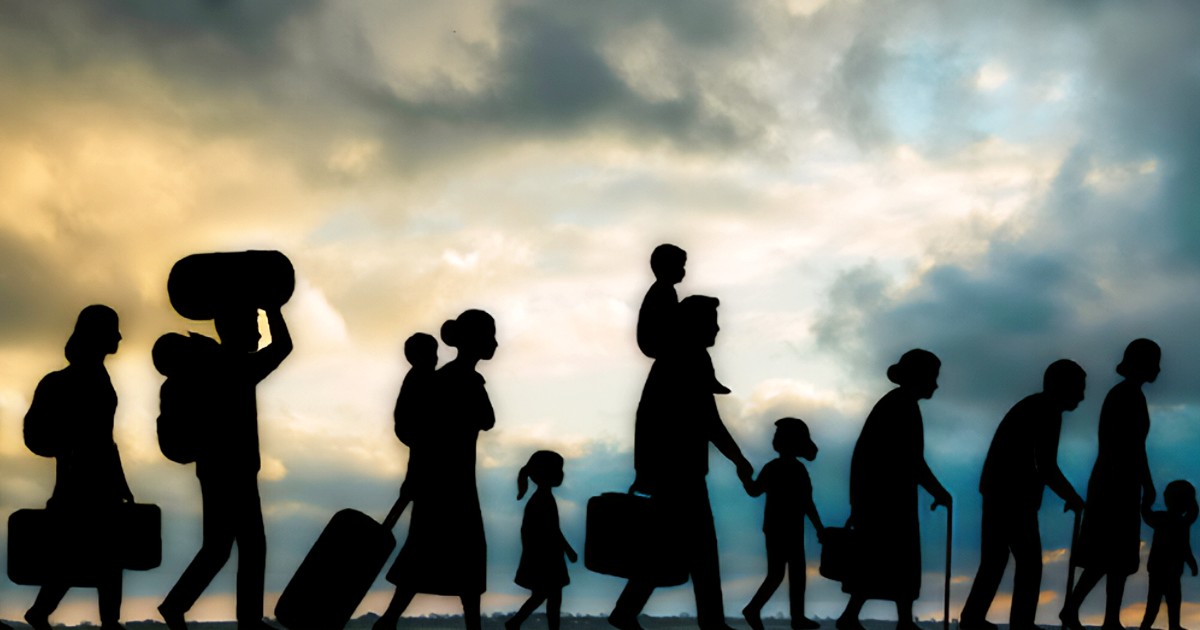
I am not a refugee, but I have experienced the effects of war first-hand.
I was born in Damascus, Syria, and came to Canada as a young child. Years later, I returned to Syria and lived there until the war began in 2011. I experienced moments of fear and uncertainty that are hard to put into words—nights of gunfire outside my window as I shielded my one-year-old son, a near kidnapping on a simple walk home and the shock of a bomb exploding just minutes away from where I was supposed to be. By God’s grace, I was able to leave safely because of my Canadian citizenship. But many others were not.
My grandparents in Syria lost the home they had built over decades, a place filled with olive trees, family gatherings and memories. They fled in the middle of the night, forced to leave everything behind in search of safety.
This is the experience of many refugees. Sitting in their homes as the walls shake and windows shatter from a nearby explosion. Watching their loved ones leave for work or school, not knowing if they will return. Losing everything—their home, neighbourhood, memories—and facing the impossible decision to flee into the unknown.
New Immigration Legislation
Today, conversations around refugees and immigrants can feel tense and divided. Recent legislative changes in Canada have raised concerns about limiting access to refugee protection and accelerating immigration decisions in ways that may affect fairness and due process. While opinions may differ, as Christians, our foundation is not rooted in politics, but in the Word of God. The question we must ask is: What does God say about this?
Scripture is clear: “Speak up for those who cannot speak for themselves … defend the rights of the poor and needy” (Proverbs 31:8-9). We are called to be a voice for the vulnerable.
We are also reminded: “When a foreigner resides among you in your land, do not mistreat them … Love them as yourself” (Leviticus 19:33-34). This is not a suggestion; it is a command rooted in the heart of God.
Yet, if we are honest, it can be easy to wrestle internally. Questions arise: Who deserves help? Are they truly in need? Are they taking advantage of the system? While we may not say these things out loud, they can quietly shape our posture.
In Luke 17, Jesus heals 10 men with leprosy. Only one returns to thank him, and he is identified as a foreigner. Jesus knew this would happen, yet he still chose to heal all 10. His compassion was not dependent on their response.
This challenges us. We are not called to serve based on what we receive in return. We are not called to judge motives or determine worthiness. We are called to love, serve and reflect Christ. Our role is to plant seeds; the work of the heart belongs to God.
Seen, Valued, Welcomed
So, how do we see the newcomer who walks through our doors? As a burden, or as someone made in the image of God?
When individuals and families come into our food banks, shelters and churches, do we show genuine hospitality? Are we curious about their stories, their culture and their journey? Or do we remain distant, offering only transactional service?
The call of Jesus in Matthew 28:19 to “make disciples of all nations” looks different today than it once did. Many of the nations we once thought we had to travel to are now here—in our neighbourhoods, ministries and congregations. This is not an interruption to our mission; it is the mission.
In the Book of Revelation, the kingdom of God is described as a great multitude from every nation, tribe, people and language standing together before the throne. This is the picture of heaven. Why wait until then to reflect it?
What would it look like for our churches and ministries to embody this reality now? To move from transactional service to transformational relationships? To not expect people to become like us, but to create spaces where they are truly seen, valued and welcomed?
Different cultures bring richness, not only in food, but in worship, prayer and expression of faith. When we embrace this, we begin to reflect the fullness of God’s kingdom.
Scripture says, “Do not forget to show hospitality to strangers, for by so doing some people have shown hospitality to angels without knowing it” (Hebrews 13:2). This World Refugee Day, may we be reminded that our calling is not shaped by fear, assumptions or opinions, but by the heart of Christ.
May we be a people who welcome the stranger, speak up for the vulnerable and serve with compassion, trusting that as we do, we participate in the work of God’s kingdom among all nations. Because when we welcome the stranger, we are not just meeting a need—we are encountering the heart of God.
Lieutenant Mirna Dirani is the resource officer, immigrant and refugee services, at Harbour Light Ministries in Toronto.
Illustration: linephoto/iStock via Getty Images Plus




Mirna, this article is worth reading. As I think about how the earliest disciples made disciples of all nations, I realize they weren’t only leaving their homes for other nations. There were already multiple nations where they lived. In the gospels and in Acts, we see both friction and richness in the relationships between Jewish and Gentile Christians. Today, we already have nations right where we live. Are we ready for both the friction and the richness that comes in engaging them in transformational relationship?