

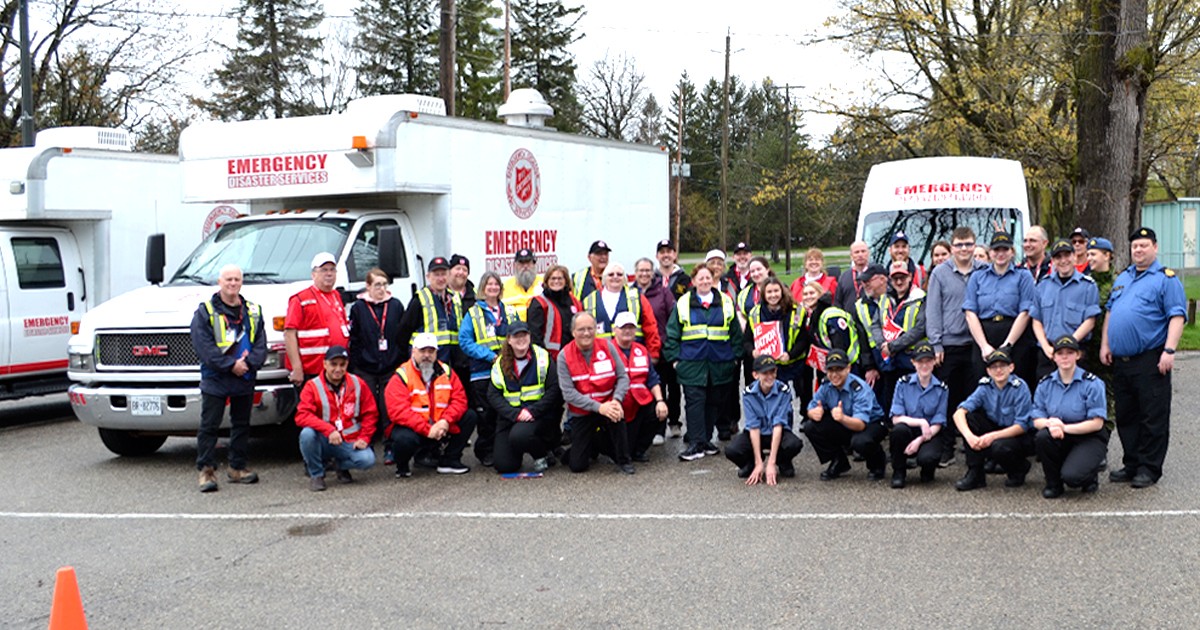
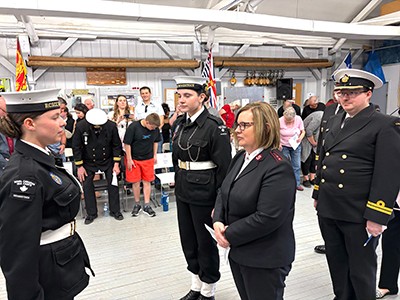
In Woodstock, Ont., a group of young sea cadets is developing vital leadership and disaster response skills through a unique partnership with The Salvation Army.
Spearheaded by Trevor McLellan, emergency disaster services (EDS) specialist for the Ontario Division and sea cadet instructor, the program expands training opportunities for youth by introducing them to the Army’s EDS curriculum. Since 2022, cadets have gained practical disaster response skills to complement their existing training while learning about the Army’s mission and emergency response work. It also encourages youth to consider volunteering with EDS after they age out of the cadet program.
“They’re interested in what The Salvation Army EDS does,” says McLellan. “We know that when they leave the sea cadets program at 19, that interest will remain. We’re investing in them now, hoping they’ll stay involved in the Army’s work in the future.”
New Opportunities
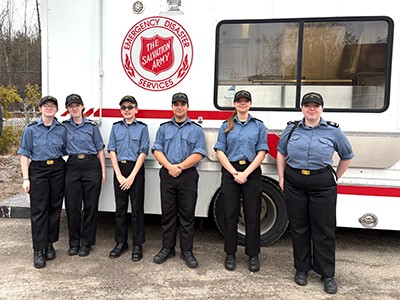
The Royal Canadian Sea Cadets is a program for youth ages 12 to 18. It provides advanced training in sailing, seamanship, navigation and outdoor survival, while developing adventure skills and teamwork, and promoting personal growth.
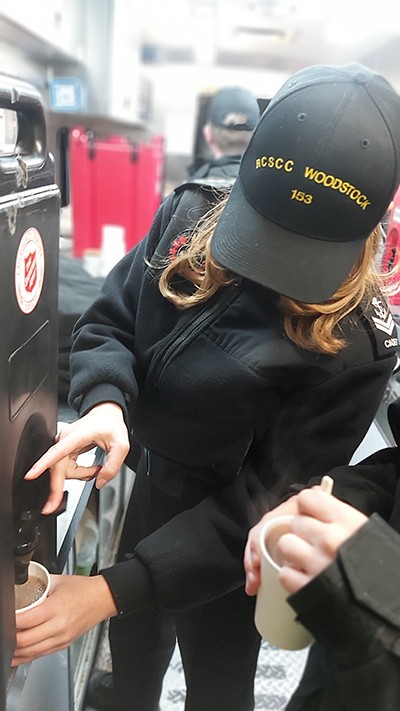
As part of the partnership with TheSalvation Army, the sea cadets complete all three of the major EDS training courses that all regular volunteers must undergo: introduction to EDS, canteen operations and emotional and spiritual care.
Though the youth can’t deploy to disasters, they participate in extensive training and attend the annual EDS training weekend at the Jackson’s Point Retreat and Conference Centre, Ont. In addition, the cadets have also had opportunities for further disaster response training through connections with the Royal Canadian Navy, such as reception centre management training and earning radio licences.
The training is not mandatory, but the youth still show up enthusiastically on Saturday mornings because they are interested in learning. Many participants also use their time volunteering with The Salvation Army toward high school requirements. McLellan also notes that he has seen several graduating sea cadets stay on as EDS volunteers.
Hands-On Help
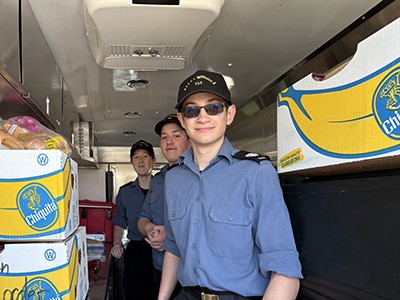
Last year, the sea cadets took on a new project, transforming one of The Salvation Army’s utility trailers that was being used as storage space. “We decided we needed to make it operational and useful again, and I thought it would be a fun project for the cadets,” says McLellan, who supervised the project alongside Adam Marshall, director of EDS, Ontario Division.
The cadets did almost all the construction work on the trailer themselves. They cleaned it out, installed countertops, cupboards and television mounts, and replaced the flooring.
“The trailer is now fully operational,” says McLellan. The trailer serves several different purposes for EDS. It will have Starlink installed, so it can act as a mobile internet café for volunteers who may arrive at a remote location without access to the internet. It can also be used as a mobile office with workstations for an incident management team.
In addition, the mobile unit can function as a respite area where responders have somewhere warm and dry to rest, eat or step away for a while.
“We weren’t teaching disaster management directly—we were teaching practical skills that will be useful throughout their lives,” McLellan adds. “We even had a parent thank us for giving these kids opportunities they never would have had otherwise.”
Investing in the Future
“Being treated as equals makes a huge difference,” says McLellan, who notes that the cadets enjoy the EDS training because it gives them an opportunity to experience advanced training as teens that would otherwise only be available to adults. “It’s not the adult team and then the kids—they’re completely integrated.”
And according to McLellan, one of the greatest advantages of investing in youth is time. Many Salvation Army volunteers, including EDS volunteers, are retired and have plenty of spare time to serve. But with 15- and 16-year-olds, there’s potential for long-term service. “If we can gain 40 years from a volunteer, that’s pretty cool,” he says.
The training experience also changes how the youth view The Salvation Army. “They don’t think of it as the thrift store, the food bank or the shelter,” says McLellan. “They think of it as working out of a canteen truck, building a communications trailer or attending a disaster conference. They see The Salvation Army very differently because of the opportunities we’re providing.”
Eighteen-year-old Phoenix Nicholson has been involved in sea cadets for six years. Before becoming involved with The Salvation Army through sea cadets, she thought it was just about thrift stores and food banks. “I honestly didn’t realize how much disaster response they did,” she says. “I didn’t know just how awesome The Salvation Army could be.”
Cadets teaches youth about citizenship, leadership and teamwork—skills that Nicholson says tie in well with what she has learned through EDS training. “Learning disaster response is really another form of leadership,” she says. “My leadership has improved tremendously because we’re put into fast-paced situations and taught to manage them. I’ve improved my quick-thinking skills and learned how to be flexible in different situations.”
Beyond practical skills, Nicholson has also learned people skills. “You need to work with your team, make sure everybody’s listening to the ideas being shared, and think through everyone’s needs. A lot of my cadet skills improved because of The Salvation Army, and a lot of my EDS skills improved because of cadets. They both strengthened each other.”
Something Special
The skills learned through EDS training are both complementary of the sea cadet curriculum and transferable to their life and career aspirations. Among the current sea cadet cohort, two of them hope to become paramedics after school, another is on the way to medical school, and several want to join the Canadian Armed Forces—all careers that play a role in disaster work and responding to emergencies.
Inspired by the success of the partnership in Woodstock, McLellan hopes to encourage other sea cadet corps to consider EDS as part of their training curriculum.
“I think every cadet in Canada should have access to this training opportunity with EDS,” says Nicholson, who hopes to continue working with The Salvation Army in the future because of the valuable experience that EDS has provided her. “Combining cadets with The Salvation Army creates something really special. The Salvation Army does so much good work for people, and it feels good to do good.”


Leave a Comment