



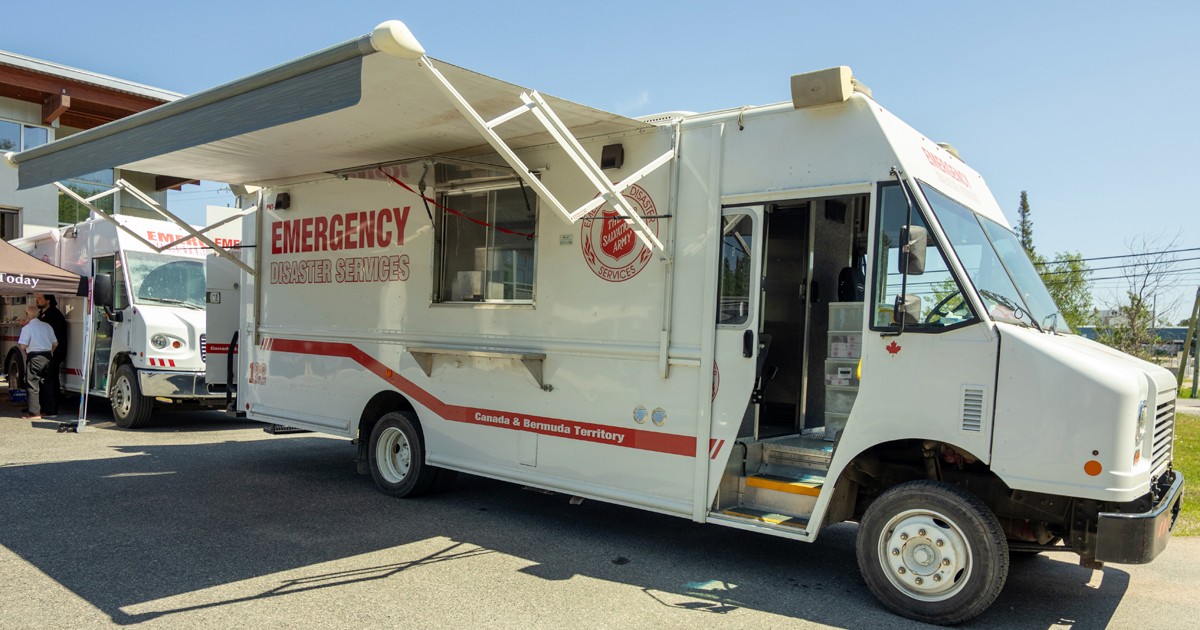
The Salvation Army has unveiled a new emergency disaster services (EDS) truck in Kenora, providing northwestern Ontario with a mobile emergency response unit capable of delivering meals, supplies and support during disasters.
Response Support
The vehicle, which will be permanently stationed in Kenora, is designed to respond to emergencies ranging from wildfires and evacuations to floods, ice storms and large structure fires.
“It’s a mobile kitchen on wheels, and it’s fully self-contained,” says Major Rick Zelinsky, territorial EDS director and public affairs director. “If there was ever a disaster in the area, we can roll up to the disaster. We have power, refrigeration and everything we need to cook meals, both for first responders at the scene, as well as people who are either evacuated or in their communities as survivors of a disaster.”
The truck fills a longstanding geographic gap between existing Salvation Army emergency response vehicles in Winnipeg and Thunder Bay, Ont.
“What it does for us is cover the northwestern strip of Ontario into Manitoba,” Major Rick explains. “We have a truck in Winnipeg. We also have a vehicle in Thunder Bay, but we were lacking one for something in between.
According to Major Rick, having a dedicated unit based in Kenora means emergency support can arrive much sooner when communities are facing a crisis.
“For this region, we can be serving people within hours,” he says. “Then, within 12 to 24 hours, we can bring in additional resources to support the response.”
Fully Functional
The truck itself is equipped with an oven, grill, griddle, tilt skillet, refrigerators, freezers and serving areas. Unlike a typical food truck, it is designed to operate in locations where power and other services may be unavailable.
“It has to be sustainable in an area where there’s no power, there’s no fuel, and we’re able to put it into action, fully functional no matter where we park it,” Major Rick says.
The Salvation Army currently has the capacity to serve roughly 4,500 meals per day using its existing fleet. Additional refrigerated trailers can be brought in to store several days’ worth of meals if an emergency response is expected to last for an extended period.
“With our two trucks we have right now, we can serve 4,500 meals a day,” Major Rick says. “We also have refrigerator trailers that, after the emergency begins, we would bring those in and be able to store five days’ worth of meals.”
Beyond food service, the Army provides hydration, snacks, and emotional and spiritual care for evacuees and disaster survivors.
“We become chaplains for people, a listening ear to support people who are probably dealing with one of the worst days,” Major Rick says.
Future plans also include equipping the truck with Starlink satellite internet, allowing evacuees to contact family members, insurance companies and emergency contacts even in remote areas without communications infrastructure.
“When you come to get a meal, you can also go on WhatsApp on our Wi-Fi and let your family know you’re safe,” Major Rick says. “If we’re remote, you can contact your insurance company and get that moving.”
“We become chaplains for people, a listening ear to support people who are probably dealing with one of the worst days,” MAJOR RICK ZELINSKY
If Disaster Strikes
The idea to station the vehicle in Kenora began during a chance conversation between Major Rick and Mayor Andrew Poirier during a Salvation Army event last Christmas.
“I said, ‘Mayor, if you can find a warm place for us to park a truck in the winter, we’ll bring a truck and put it right here in town,’ ” Major Rick recalls. “He got back to me the same day and said, ‘We’ve got a solution. We’ve got a place for you to park your truck.’ ”
While the truck is intended primarily for emergency response, residents may also see it at community events throughout the year.
“It’s not just static where it sits in a garage until there’s a disaster,” Major Rick says. “It can be used locally for events to be part of the civic culture in Kenora and the surrounding area.”
The Salvation Army is now seeking local volunteers to help operate the vehicle during emergencies. Interested residents will receive training in food service, disaster response and support for people affected by emergencies.
For Major Rick, the new truck represents an important investment in the region’s ability to respond when disaster strikes.
“Our hope is that we never get deployed and that we’re always just good and ready,” he says. “But I have to be honest, these things do happen.”
Reprinted from Kenora Miner & News, June 8, 2026


Leave a Comment