


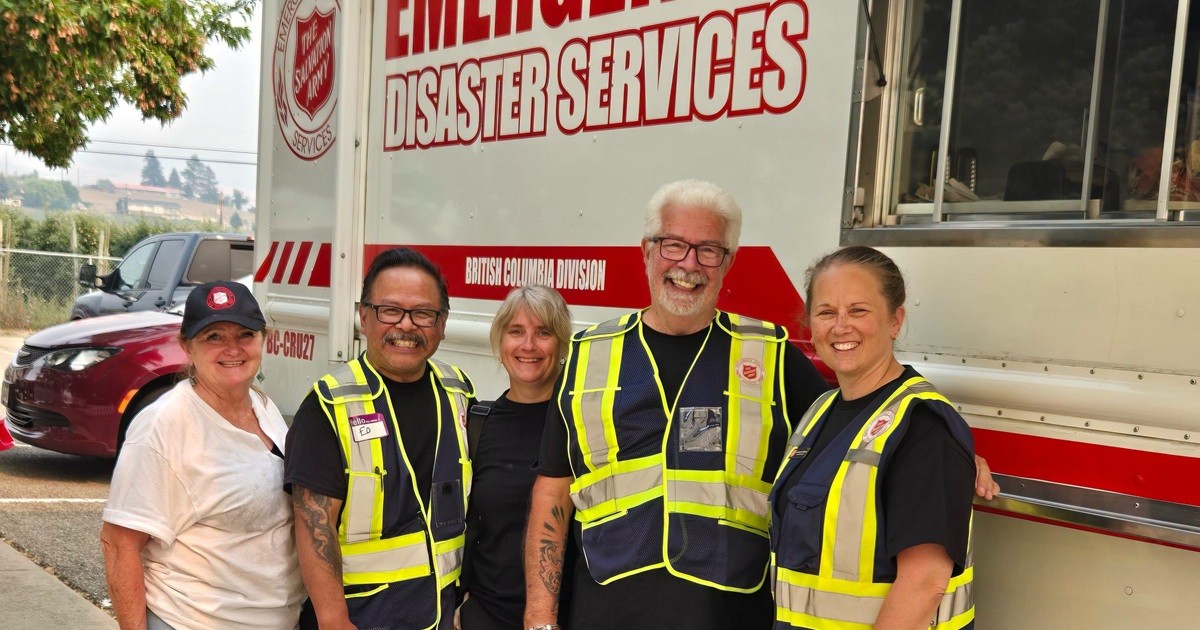
It has been a busy summer for The Salvation Army’s emergency disaster services (EDS) in British Columbia as it has provided assistance to wildfire evacuees and first responders over the past two months.
Since June, The Salvation Army has supported wildfire responses in communities including West Kelowna, Comox, Boston Bar, Chilliwack and Kamloops. EDS teams have served food to firefighters and people who were forced to leave their homes. They’ve also delivered essential supplies to vulnerable areas and provided emotional and spiritual care to those displaced.
“Our wildfire season started in June and we have been responding to emergencies nonstop since July 7,” says Ian Pollard, divisional director of EDS for British Columbia.
In mid-June, EDS teams deployed to support evacuees of a small wildfire in West Kelowna. A few days later, they travelled to Comox on Vancouver Island to provide meals for firefighters battling another blaze.
During this time, EDS also equipped remote areas of British Columbia, many of which were First Nations, with fire skids that are firefighting systems to be mounted onto pickup trucks.
In early July, The Salvation Army supported evacuees from Boston Bar by providing meals, snacks, drinks, hygiene kits, gas vouchers and emotional and spiritual care.
Since July 24, the focus has been on responding to an out-of-control wildfire that displaced residents of Clinton and the community of 70 Mile House. Most evacuees fled to a reception centre and group lodging site in Kamloops where EDS is providing them with three meals a day and essential items.
“We are here to provide comfort. A lot of them have travelled a long way, so they may not have had a meal since being on the road. We are also there to offer a listening ear,” Pollard adds.
Human connections are just as important as nourishment.
“Our work gives us the opportunity to have those good conversations with evacuees and learn about their needs. Some are more complex than others, so by getting to know them, we can refer them to other resources that are available in the community,” Pollard shares.
The Salvation Army has collaborated with local agencies in each wildfire response this summer. These partnerships elevate the level of care provided.
“When it comes to other organizations working alongside us, we try to complement one another rather than duplicate services, so together we can have a bigger impact,” Pollard says.
At the time of publication, The Salvation Army’s response in British Columbia continues to expand as additional communities are impacted by active wildfires.
To donate toward the wildfire efforts, visit salvationarmy.ca/wildfire




Leave a Comment