




Born between 2010 and 2024, generation Alpha is the first generation to grow up fully immersed in a digital world. Connectivity, social media and online communities have been part of their lives from an early age, shaping their development and the way they understand and engage with the world around them. And with this increasingly connected world come questions of identity, belonging and purpose for today’s youth.
Gen Alpha in Canada: The Next Generation is a recent study by OneHope International, distributed by Alpha Canada, that explores how preteens think about and respond to concepts of faith, identity and spirituality. It asked what they know, what they believe and how those beliefs apply in their everyday lives.
Salvationist staff writer Abbigail Oliver spoke with Shaila Visser, global senior vice-president of Alpha International and national director of Alpha Canada, to explore some of the study’s key findings and what it means for The Salvation Army’s church communities.
Can you explain the study and some of its key findings?
Shaila Visser: OneHope International commissioned this research to help better understand preteens’—specifically kids 11-13—perspectives on faith. Alpha Canada was pleased to collaborate and share this important research so that church leaders and parents could understand how preteens were exploring and experiencing spirituality.
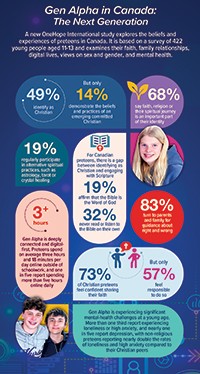
Gen Alpha is a spiritually curious generation. Sixty-eight percent of preteens said that their spiritual journey is an important part of their identity. And even among those that self-identify as non-religious, nearly a third believe in a spiritual higher power. These trends are different from the millennial and gen X generations that came before.
Additionally, 19 percent of gen Alpha report that they regularly participate in alternative spiritual practices such as astrology, tarot cards, manifesting and crystals. They aren’t just curious; they are trying these practices. They’re searching for answers using what they know and what is easily available to them—the digital space.
Young people may not explicitly say they are interested in learning about Jesus, but they believe there is something more out there and they’re asking questions about it.
There’s a huge opportunity to help this generation explore faith, life and Jesus.
What role do parents and families play in faith formation for young people?
SV: Previous generations had a greater degree of home and family influence regarding religion. Today, fewer young people have an understanding of who Jesus is or what it means to practise Christianity because their parents don’t have a background in it, and they may not have seen it at home.
The study also shows a desire to lean on trusted guides, including parents, guardians, adults and spiritual mentors, who listen, care and have wisdom to share. The report indicates that 83 percent of preteens turn first to their parents or family for spiritual guidance. Yet, the research also shows that while parents are the most trusted voice, most preteens rarely see their parents model faith. There’s a gap between what they’re looking to their parents for and not being able to see a faith life in them. So that’s why they end up talking to other people about it and looking online.
Much of the research we’re seeing is showing that as much as gen Alpha is online, they are also very interested in connecting in person. So, it’s important to have spaces for them to connect in person with peers, trusted adults or a church community.
Gen Alpha wants relationship. They want to be known. They want to be accepted. And they want to be cared for. And they want to see models of wisdom and faith. Every generation is needed in helping these young people meet Jesus.
We’re also seeing a lot of young people opening this door for their families. We’re often hearing stories at Alpha of children as young as seven or eight coming to faith in Jesus through a friend and then bringing their parents along to church.
What kinds of opportunities does this research present for The Salvation Army and the church community?
SV: Churches have an opportunity to speak to parents and remind them that parents’ voices matter most. I think the question for Christian parents is, how are you modelling that in your daily life?
Kids need to see not just how faith forms who they are but also how they make decisions and build relationships. Young people need faith modelled to them by parents, trusted adults and church communities.
For the church in Canada, the question then becomes, how can we help parents and mentors think about how their faith is formed in daily moments, not just by going to a Sunday service or Bible study once a week?
And outside the church, there is an opportunity for parents to encourage their Christian children to model this faith in their own circles. Invite their friends to church or youth group or Alpha in their school. Help others find a way to investigate spirituality.
What is Alpha taking away from this study and how is that influencing your strategies for ministry to young people?
SV: This research has helped us think about how we serve the church to reach young people. One of the core findings that I found exciting was to learn that this spiritual formation is beginning even earlier than we thought, in younger children. Young people are asking these deep spiritual questions—not just older teens and university-aged individuals. In response, we’ve tailored our newest Alpha Youth film series toward 12-, 13- and 14-year-olds so that they can have a place to explore faith.
The other thing that has shaped our strategy is that Christian preteens are surprisingly bold. Seventy-three percent of them feel confident sharing their faith. What does it mean for us to create spaces for youth to learn and lead, to help them create spaces where their friends can hear the good news of Jesus?
What would you say to parents, youth leaders or members of the church who feel lost with the younger generation, or who hope to better reach the youth in their church and communities?
SV: I think every Christian has a part to play in serving gen Alpha. Young people are not looking for black-and-white answers or for us to tell them what we believe and expect them to follow. They’re looking for interest. They’re looking for mentors. Be curious. Ask them questions, sit with them, remember the details of their lives. Tell them that you’re praying for them. Show love by engaging with them.
I wish the whole church could know it so that we can all play our part in helping the Holy Spirit move among gen Alpha in Canada. It’s really exciting days for the church.
To view key findings from the Gen Alpha report, click on the image below to download a PDF:
Photos: Jerimi Jones
This story is from:




Leave a Comment