



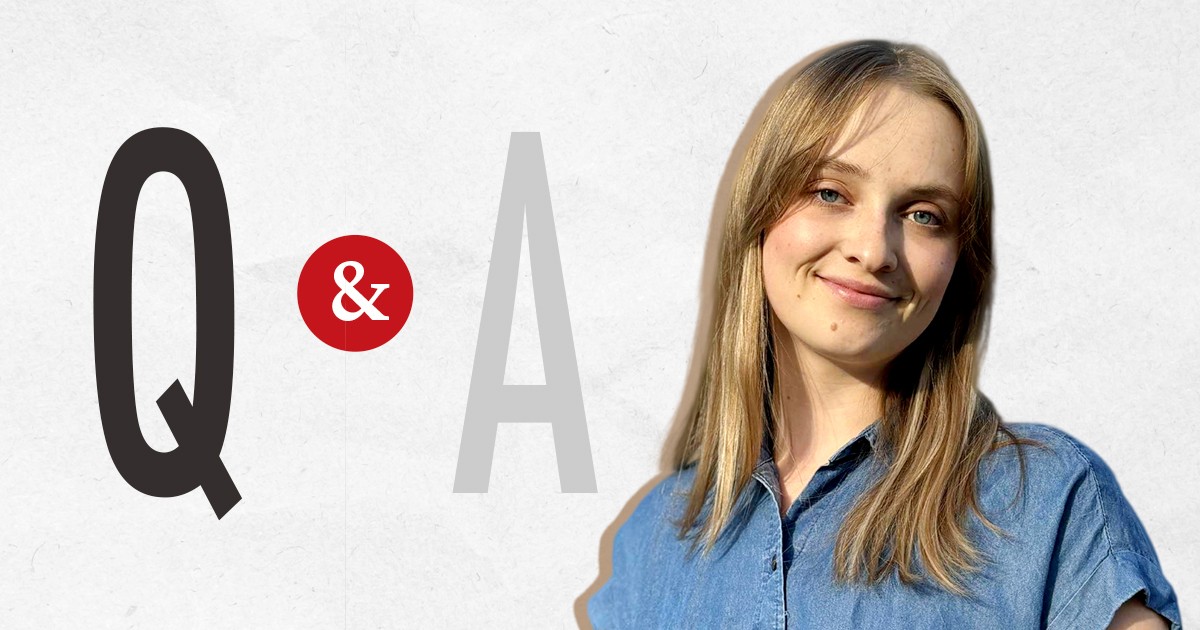
Ivy Foster is a chaplain with The Salvation Army’s community services in Calgary.
Who has had the biggest impact on your faith?
My parents had a huge impact by providing a constant loving environment for growing in my faith at my own pace and by modelling Christian values. From my mid-teens until my early 20s, I was involved in camp ministry at Camp Evergreen, Alta., which was foundational in fostering my relationship with Jesus and discovering my own sense of purpose. Attending Alberta Bible College brought me close to many strong Christians and curious theologians. In college, I realized that learning about God and his character helps me to feel closer to him.
How has God sustained you through difficult circumstances and provided for your needs?
I’ve dealt with chronic pain and fatigue for many years now, and it was frustrating that doctors couldn’t give me a clear diagnosis, generalizing it as fibromyalgia. This has made my day-to-day life very difficult. Though annoying, I have felt sustained by God with the perspective that these problems give me more empathy for others with health problems, a vital perspective in chaplaincy.
This past winter, I was told it was undiagnosed Celiac disease that has been largely contributing to my pain and fatigue. I’m thankful that this factor was discovered now, rather than in my middle years, which is common for people who don’t have stomach symptoms. Finally, I know one way to help my health, and although it is not perfect, I feel much better.
And since meeting my now husband, Carl, three years ago, I have also experienced a newfound thankfulness for the ways that God has not only provided for my needs but given me far more blessings than I deserve.
Why did you become a chaplain?
After working in camp ministry, I felt a calling to pursue ministry as a vocation. Not knowing what that could look like, I assumed I’d end up in a church somewhere. One day in my third year of college, I overheard a classmate say, “Chaplains do more listening than talking," and it was a lightbulb moment for me—the only one I’ve ever had. I don’t enjoy giving sermons and my health makes it important to maintain clear work boundaries, so it clicked that chaplaincy was the type of ministry I wanted to pursue. I feel more fulfilment in one-on-one conversations, doing more listening than talking and allowing others a place to put their emotions without judgment, and doing my best to water seeds of faith.
What draws you to work with The Salvation Army?
I am drawn to work with the Army because I can provide spiritual care to people of all backgrounds. I appreciate that it’s accessible for people who feel they don’t belong to a church community, and I enjoy that my role lets me support other community programs and build relationships with those clients. The best part of my job is when I come away from a spiritual care visit where a client feels encouraged or understood—that brings me the most joy in my work. I don’t always have the benefit of witnessing the outcome of God’s work in a client’s life, but I am always so happy when I get to celebrate a positive development.
What’s a piece of art that has nourished you recently?
In these past few months, I’ve been listening to an album called Manna by Chris Renzema. I go through periods of time where I have high anxiety in the mornings, and the lyrics and guitar help toease that.
My newly retired director, Major Glenda McKenzie, recently emailed me a poem called “Why Bother” from The Second O of Sorrow by Sean Thomas Dougherty. He writes, “Because right now there is/someone/Out there with/a wound/in the exact shape/of your words.” This is a type of encouragement that I need very often. When I am feeling like “Why bother?” I’ve noticed that God often sends me reassurance to bring me out of those blues.
This story is from:




Leave a Comment