


Articles of Faith is a new series on the 11 doctrines of The Salvation Army.
In the past 500 years, Christian denominations have claimed many doctrinal distinctions. While that division is disappointing, it is still encouraging that the biblical record remains compelling enough to produce remarkable agreement on the central affirmations of historic Christian faith: the Trinity, the deity of Christ, the Incarnation, Christ’s death for sin, his bodily Resurrection, salvation by grace and the realities of judgment and eternity.
That is why the first doctrine of The Salvation Army is not merely first in order, but also in importance: “We believe that the Scriptures of the Old and New Testaments were given by inspiration of God, and that they only constitute the Divine rule of Christian faith and practice.”
That phrase, “they only,” is no incidental clause. It is the qualifying assertion that gives substance to everything that follows. No other authority is equal to Scripture in determining what we believe and how we live, worship, lead and serve. Tradition may assist us. Scholarship may help us. Experience may affect us. But none of these rivals the authority of the Word of God.
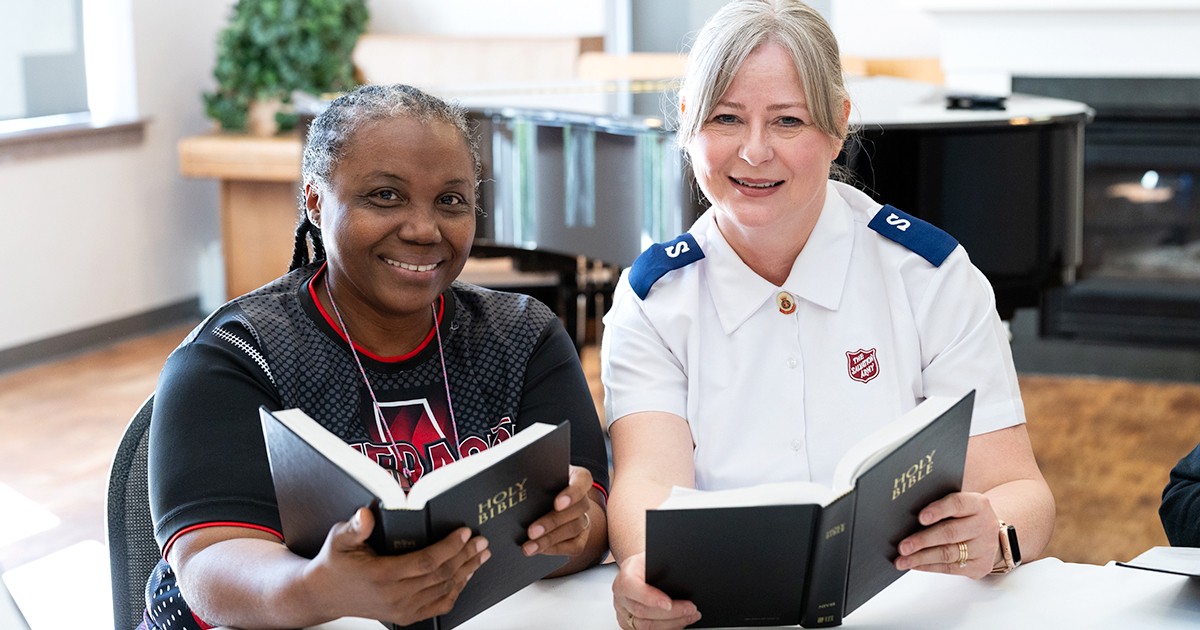
Our Founders understood clearly that The Salvation Army could never remain what it was called to be unless it coalesced around theological certainty grounded in our triune God’s self-revelation in Scripture. Such a conviction requires that our policies, procedures, plans and priorities be reflective of and subservient to Scripture. Integrity demands, then, that in every meeting, deliberation and ministry decision we proceed with an open Bible—not merely as a symbol on the table, but as the governing authority in the room.
Yet I fear we are drifting from that posture. We hear much today about “mission drift.” But is that ever the first sign of trouble? Is it not almost always preceded by theological drift? When the Bible is reduced to guidance rather than governance, we are planting our feet on shifting sand rather than on solid rock.
Doctrine 1 confronts that drift directly. It reminds us that God has spoken, and that he has not left us to construct faith out of intuition, sentiment or imagination. Why must Scripture govern faith and practice? Because it alone gives us what nothing else can: the self-revelation of God.
The Old Testament is of immense value because it is the inspired record of our triune God’s self-revelation in history, covenant, judgment, mercy and promise. It also reveals God’s redemptive plan—who needs it, why we need it and that the plan is ultimately not a system but a person.
The Old Testament is the necessary prelude to the New Testament. At the Last Supper, Jesus takes the sacred remembrance of Passover and, in effect, tells his Jewish disciples that they are no longer to look back merely to the lamb and the deliverance of Egypt. They are now to understand that he is the true Lamb of God who takes away the sin of the world. That is one of the most compelling transitional moments in the Gospels. The Bible is not a loose collection of religious reflections. It is one unfolding revelation, intricately woven by the Holy Spirit and centred in the coming Messiah, Jesus Christ.
And Scripture does not only tell us how we are redeemed. It also answers the question, “How then shall we live?” It reveals the work of the Holy Spirit, the nature of the church, the call to holiness and the shape of obedience. It tells us what is yet to come. While eschatology contains mystery, one thing is absolutely certain: the Word of God does not permit us to invent or negotiate our own terms of salvation. Scripture makes plain that only those who trust Jesus Christ and his finished work may enter the eternal home of the redeemed—what we call heaven. We could not know this without biblical revelation, and we could not know it with confidence apart from the credibility and authority of Scripture.
That is why Doctrine 1 must remain first. The Scriptures—“they only”—constitute the divine rule of Christian faith and practice. If that conviction is weakened, we will not merely lose clarity—we will lose our bearings altogether.
MAJOR LORNE PRITCHETT is the corps health officer in the corps mission department at territorial headquarters.
Photo: Jerimi Jones
This story is from:




How refreshing to read this article! Thank you for your holy boldness to remind us of the foundation of our faith and doctrine - the Word of God. May we be faithful to the governance of His Word, and make it central in all that we do.