



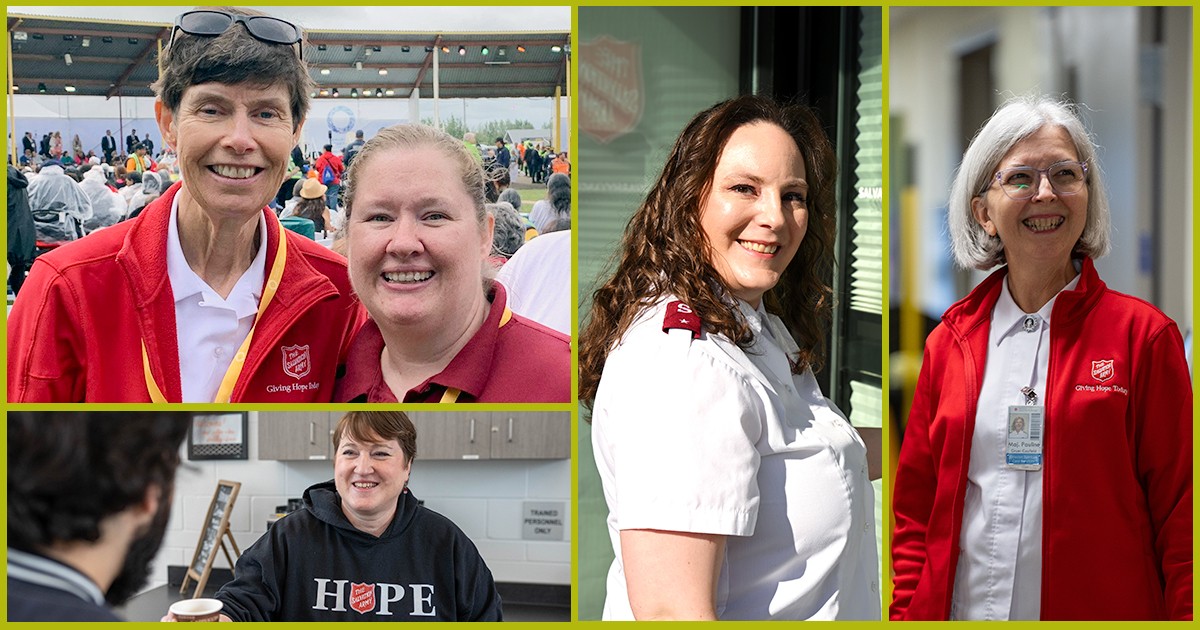
Captain Laura Van Schaick, territorial gender equity officer, recently sat down with General Brian Peddle (Rtd) to discuss the ongoing work of gender equity within The Salvation Army—both internationally and here at home. Their conversation reflects on the progress made, challenges encountered and their hopes for the future, and highlights the importance of recognizing and empowering the gifts and leadership of women and men across the Army.
Captain Laura Van Schaick: General Peddle, before your retirement as international leader of The Salvation Army in 2023, one of your key concerns was gender equity. How did this come about, and how did you feel taking on such an important issue?
General Brian Peddle: I became General after serving as the Chief of the Staff with General André Cox. In one sense, I knew of my inheritance regarding this matter. The gap between theology and practice was already lurking in the shadows and in my commencement as General, gender equity was one of my declared priorities.
In a time when women were not commonly accepted as church leaders, William Booth was countercultural. In an early directive, he stated, “A woman officer can hold any rank within The Salvation Army, up to and including the rank of General.” A bold statement, but one that came true in three women: General Evangeline Booth, General Eva Burrows and General Linda Bond (Rtd).
And yet, it is important to acknowledge the gap. Phrases like systemic gender issues, default appointments, cultural norms and “it’s a man’s Army” bothered me. I recall declaring “enough is enough” in an article in The Officer magazine.
The focus from the General’s office was on the 300-plus officers needed to lead at the executive level. Some of our single women officers were recognized, but nearly 50 percent of our 16,000-plus contingent were married women and they were not visible in the appointment process. To progress this agenda, steps needed to be taken.
LVS: What did those steps look like?
BP: We established a gender equity task force at International Headquarters (IHQ), led by Commissioner Lisbeth Wellander and Commissioner Mark Tillsley. The team was composed of officers from each zone of The Salvation Army. It was shortly after the commencement of our journey that we heard about what was happening in the Canada and Bermuda Territory, and I recall asking the chairs to reach out with the hope we could learn from each other.
LVS: Many of us in Canada and Bermuda were likewise paying close attention to the gender equity work at IHQ. Here, the work began formally around the same time, in 2020, with the appointment of a gender equity advocate. The role was tasked with conducting interviews with women officers across the territory to assess the presence of any gaps in gender equity.
While The Salvation Army has historically affirmed gender equality in principle, and both Canada and Bermuda are generally regarded as progressive in advancing women’s rights, the experiences shared by women officers revealed a persistent gap between our stated theology and lived practice, one that aligned with the challenges being addressed at the international level.
Specifically, we heard about concerns related to default appointments and entrenched domestic stereotypes, particularly affecting married officers. Additionally, concerns were raised regarding limited access to leadership development and training opportunities for all women, as well as the underrepresentation of women in senior leadership roles, resulting in fewer visible role models.
As you conversed with officers around the world, what were you seeing at the time with respect to the lived experience of women officers?
BP: I saw two things, particularly as it pertains to the subject of default appointments to women’s ministries. On one side, when default appointments are the wrong appointment, no one wins. It is mean, derogatory, fails in honouring equity in our ranks and ignores a person’s gifts.
On the other side, ministry to women should not be considered something negative. If we look at the male/female demographics in the Army, women easily outdistance men in their membership, engagement and overall resourcefulness. When women are led well, it makes a difference for the kingdom.
In Africa and Southeast Asia, men took leadership roles and often women took default appointments connected with ministry to women. At the end of the day, there was nothing “default” about it. Women led a larger part of membership, their ministry made an impact, and it gave them a place at the table and a voice in the meeting.
Still, I remain confident that the changes are moving in the right direction.
LVS: What changes are you referring to?
BP: With the support of the gender equity task force, we began poking at systemic issues. Despite what I’ve just shared about ministry to women, it was obvious that default appointments were an issue. The IHQ appointments board started to ask questions such as, “If officer A is given a specific appointment, then is it necessary for officer B to receive a traditionally linked appointment?”
Another thing we did was to talk about the leadership of a territory in the context of perceived needs, and then secondarily ask the question, “Which one in the couple is best suited to lead?” Sadly, our women were not always ready, despite exhibiting the right gifting. A further response was needed, and that meant more exposure to board rooms and decision-making, and an improved understanding of business and finance.
The hardest realization for me was that I would not likely see a lot of results in my term as General. Fortunately, there were runs on the board: married women officers were appointed to lead the Pakistan Territory and the Denmark and Greenland Territory. We could do it. I celebrate the fact that since my term, more married women are being recognized and appointed. We modelled it at IHQ first and then encouraged territories and divisions to do the same.
Other heart-wrenching realities existed in forms that were harder to deal with. Within the wider equity challenge were issues of lack of opportunity, including the availability of education, training and the money needed to participate. Often men were given preferential treatment. I recall arriving in a territory to discover several women officers sharing an office and a single laptop, while each husband had his own. We made efforts to remove those barriers for all officers.
Another barrier we tried to tackle was culture. There were places where our attitudes and actions were culturally OK, but they were not Christian and did not honour all those who were called, trained and ordained. I called out the Army culture when it seemed to be behind the country’s culture where we served. I recall a country where it was hard to appoint a woman, and yet there had been a woman prime minister. We were holding on to our created Army culture.
LVS: I commend you for your efforts, and the efforts of the gender equity committee of the day. This progress is indeed encouraging. General Lyndon Buckingham and his team are staying the course, and I am sure there will be more celebrations to come.
Here in the Canada and Bermuda Territory, I am also observing a growing commitment to addressing gaps in gender equity in meaningful and tangible ways. More women are being appointed to senior leadership roles, including positions such as territorial commander, chief secretary, divisional commander and area commander. These appointments provide visible and credible role models for emerging leaders across the territory.
We are also placing a strong emphasis on early formation. Intentional conversations about the importance of gender equity are taking place with cadets and lieutenants at the outset of their officership. By establishing this foundation early, we are reinforcing a culture in which both women and men are recognized, valued and affirmed in their gifts and capacities.
BP: I celebrate this with you, and I sense that the generations to come will handle this better. As couples, in particular, I hope we can recognize each other’s gifts. And because this has been a little one-sided through the years, let me stand as a married man and say to other men, “Give way,” especially when you share ministry with a woman who is gifted for leadership.
LVS: Speaking of leadership, there has also been a more intentional investment in leadership development for women in the territory. This includes increased opportunities to participate in formative programs such as International College for Officers, as well as access to executive coaching and continuing education. These initiatives are helping to equip women with the skills, confidence and networks necessary for leadership at all levels.
We are also closely monitoring membership and participation on all boards and committees and striving for gender equity at decision-making tables at all levels of the movement.
BP: I think the raising up of leaders is critical to our future. We don’t have the luxury to overlook who God has given to us, both men and women. I believe this is also a matter of stewardship, and if we are not faithful in using the resources we have, should we expect more?
LVS: I completely agree. This is a matter of stewarding the time, talents and giftings of the women and men God has called to officership. While there is still important work ahead, I am encouraged by the growing awareness, intentionality and action we are seeing across the Army. As we continue to create space for the gifts and leadership of both women and men to flourish, we strengthen not only our mission, but our faithfulness to God’s calling on all who serve.
GENERAL BRIAN PEDDLE (RTD) was the international leader of The Salvation Army from 2018-2023.
CAPTAIN LAURA VAN SCHAICK is the corps officer at Barrhaven Church in Ottawa, and the territorial gender equity officer.
This story is from:


Leave a Comment