


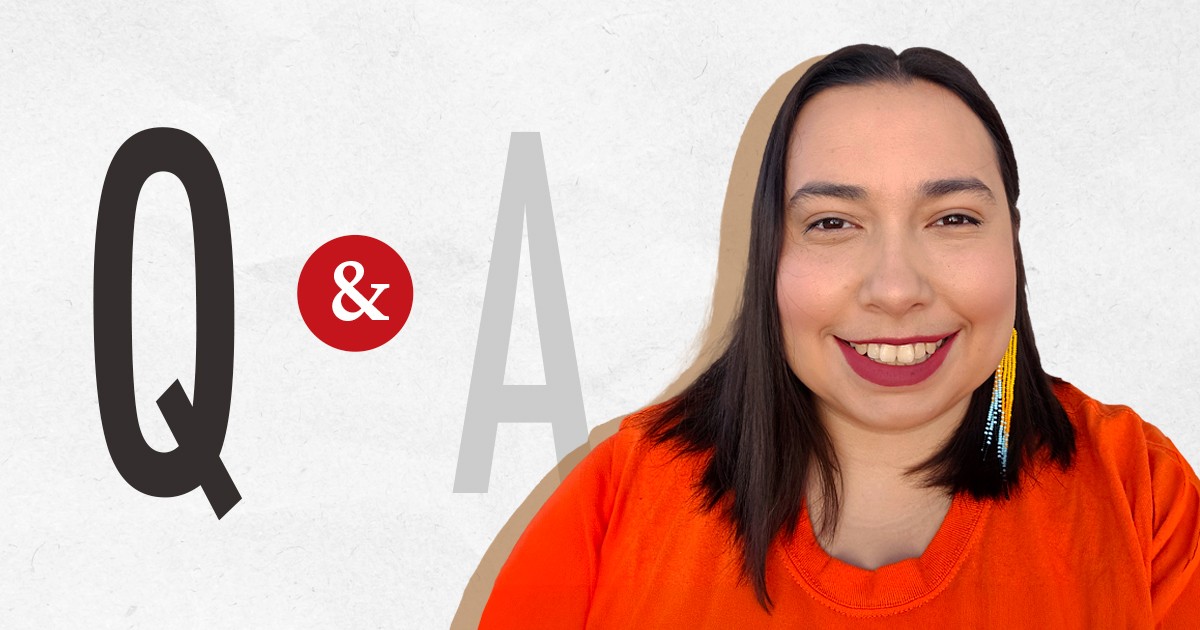
Mackenzie Griffin is the Indigenous liaison specialist for The Salvation Army in Kelowna, B.C.
What was the religious or spiritual background of your childhood?
I grew up in the Pentecostal tradition. At 16, I felt called to pastoral ministry, but decided to pursue education outside Christian institutions first.
During my undergraduate degree, I began reconnecting with my Indigenous identity. My maternal grandmother attended residential school and did not pass down our language or traditions. I felt that loss long before I had words for it. Reconnecting felt like discovering a hole in my heart—only tended through story.
I began asking: What does it mean to be both Indigenous and Christian? For years, I had received the message—explicitly and indirectly—that Indigenous culture was spiritually dangerous and sinful, and faithful Christianity required assimilation into whiteness.
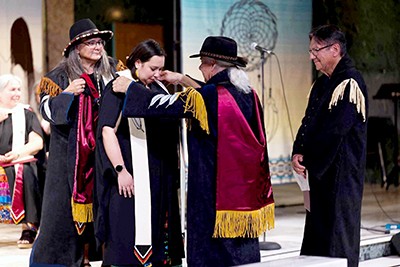
An Indigenous Learning Community
While studying theology with NAIITS: An Indigenous Learning Community, I began challenging those assumptions. I discovered that I didn’t need to divide myself to follow Jesus. My faith could become more rooted, relational and whole.
How is your story connected to the story of the land?
I have called four lands home, each represented by a tattoo—four turtles, mapped in watercolour ink, on my left shoulder. For me, as a Cree and Saulteaux woman, the turtle is a reminder that creation carries wisdom and that knowing who we are begins with knowing where we come from.
The first turtle represents the Rocky Mountains near Sunchild First Nation, where my mother’s family is from. The second represents the Saskatchewan prairies of my father’s family. The third is the hill behind my childhood home in the forests north of Edmonton. And the fourth represents the Okanagan Valley—which has come to feel most deeply like home.
How did you first encounter The Salvation Army?
I first met Captains Jennifer and Rob Henson, corps officers in Kelowna, through a friend who was connecting local Christian leaders interested in truth and reconciliation. For a year, we met monthly with another community leader, asking what meaningful action might look like.
Eventually, we hosted KAIROS blanket exercises with Elder Major Shari Russell. Those gatherings led us to ask what relational reconciliation requires and how we cultivate healthy spaces for dialogue within the church. We then formed the Reconciliation Collective, a monthly storytelling circle. With guidance from Elders, the circle explores Syilx creation stories and what they can teach us about living well together today. This gathering became my doorway into a relationship with The Salvation Army.
In your role with the Army, where do you see signs of reconciliation?
For me, reconciliation is the ongoing work of restoring right relationship—with ourselves, Creator, one another and creation. It is built through small, faithful steps repeated over time. Ongoing harm, apathy, fear and settler guilt can make it difficult for healing to occur between the church and Indigenous Peoples. As an Indigenous liaison specialist, I facilitate learning opportunities that are rooted in the land and deeply relational. Through intentional practice and relational storytelling, participants embody the work of becoming a better relative. I see signs of reconciliation when people become willing to hear difficult stories, ask more honest questions and live out their responsibilities to one another in love.
What gives you joy and purpose?
I find joy in stories: hearing them, telling them and creating spaces where people recognize themselves within a larger narrative. I feel most purposeful when I help people locate themselves in relationship and consider the responsibilities that we have to one another and the land.
My work brings together parts of myself that once felt incompatible: faith, culture, truth and creativity. It gives me hope to see someone move from fear or uncertainty into curiosity, relationship and action. Through story, I tend my relationships and carve a path that future generations can follow, just as I follow the steps of so many others before me. This is the ongoing process of becoming a good ancestor.
This story is from:


Leave a Comment