




The Salvation Army appears in a new episode of Historica Canada’s iconic Heritage Minute series, highlighting the generous response of Gander, N.L., in the aftermath of the terrorist attacks on September 11, 2001.
In the wake of the tragedy, American airspace was promptly closed, leaving thousands of airline passengers stranded in Gander. The Salvation Army played a significant and compassionate role in this response, helping distribute meals and organize food storage at a local hockey rink, shelter passengers at the corps, hand out clothes and other necessities, and provide pastoral care to those in need.
In March of this year, representatives from Historica Canada contacted The Salvation Army to request its participation in the Heritage Minute.

To recreate the 2001 events, 12 members of Gander Corps gathered at the airport for a full day of filming. They filmed scenes including the lines of passengers receiving assistance from The Salvation Army and the Red Cross, as well as shelter spaces with cots, food distribution and clothing donations. Other scenes featured children helping distribute sandwiches and passengers watching news coverage as the attacks unfolded on TV.
“The first scene shows the passengers getting off the planes, lining up inthe airport and wondering what was going to happen to them,” explains Major Pam Goodyear, then divisional secretary for public relations for the Atlantic Division, who also participated in filming.
Among the cast was Rick Mercer, comedian, author and native Newfoundlander, who portrayed Claude Elliott, the mayor of Gander at the time, who also happened to be a Salvationist. He walked among the passengers, comforting them as they waited. Salvation Army volunteers interacted with passengers as they would have during the actual emergency response, offering support and assistance.
Army volunteers were dressed in full Salvation Army uniforms, branded clothing and aprons. Some in the cast had personally assisted during the original 9/11 response and were keen to play a role in the re-enactment. Producers also conducted interviews with several of the individuals who were on the ground in Gander during 9/11.
“During filming, we even had people coming up and thanking us for our work during 9/11,” says Major Goodyear.
For Major Goodyear, the project highlights a turning point in the history of Salvation Army emergency disaster services in Canada.
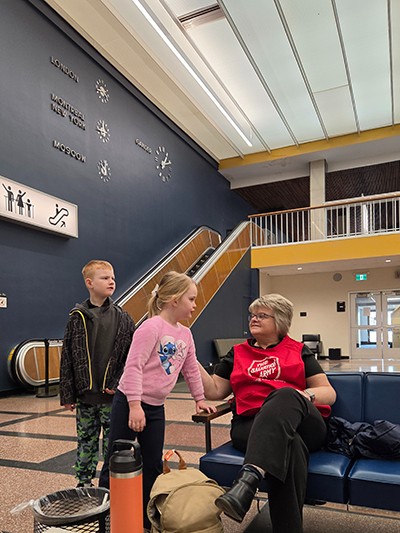
“I think 9/11 was where much of our emergency response work really became organized and developed into what it is today,” she says. “This Heritage Minute also raises the profile of The Salvation Army, particularly in Newfoundland and Labrador, where we are often seen primarily as a church rather than for our social and emergency disaster services. A project like this helps show that while we are a church, what we do extends well beyond what people might traditionally associate with church life.”
Beyond highlighting the Army’s role in the response, Major Goodyear says the story demonstrates the power of communities coming together during times of crisis. “Telling stories like this is important because it shows what we do, but it also engages people in different ways of serving,” she explains. “You don’t only have to play in a band or sing in the songsters. There are many ways for people to be involved in The Salvation Army.”
Watch the Heritage Minute:
Watch the behind-the-scenes making-of video:


So proud of "us" - Salvationists and Canadians, even though I'm not a Newfoundlander and wasn't there!