
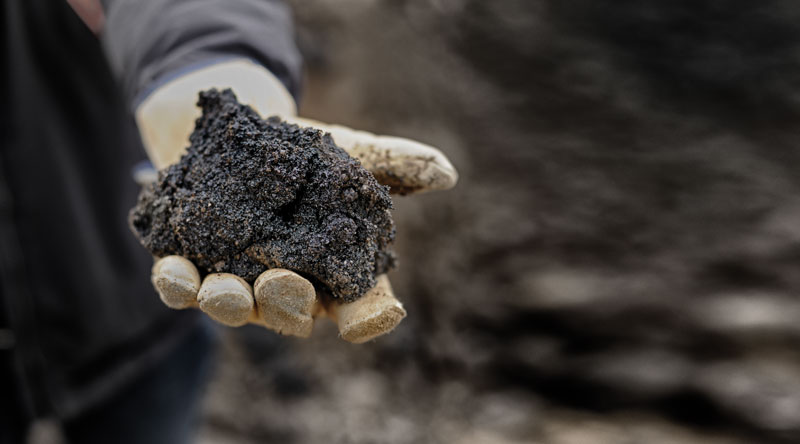
What’s the first thing that comes to mind when you think about oil? Perhaps you remember the oil-covered duck in the Dawn dish soap commercial. Or maybe you think of the ability to power your vehicle. Or, if you live in certain parts of the country, employment.
A few nights ago, I turned on my oven to roast some local veggies and a delicious ouananiche (Labrador landlocked salmon). Our family gathered around the table and thanked Creator for our meal. Later that evening, as I scrolled through Facebook, my newsfeed was flooded with articles about the proposed expansion of the Kinder Morgan Trans Mountain pipeline. I found myself falling deeper and deeper into the world of “big oil.”
From my couch on the East Coast of Canada, I felt disconnected from the West Coast. Then a lightbulb went on. I realized the issue was closer than I imagined. Our kitchen appliances, our furniture, our clothes, even the phone I was using—almost everything in our home—required the one ingredient at the root of this political debate: oil.
Oil has become a household necessity. In 2017, Canada produced 1.7 million barrels of oil per day (96 billion litres), most of which was shipped to the United States. Texas-based Kinder Morgan currently transports 300,000 barrels per day from Edmonton to refineries and export terminals in British Columbia and the state of Washington. In 2013, the company applied to expand the pipeline to 890,000 barrels per day, which would include a new pipeline, 12 pump stations, three marine berths and 19 storage tanks.
The expansion would triple product distribution, increase employment and benefit the economy. It would also increase water traffic, disturbing the natural habitat for marine life. Many Indigenous groups, as well as the B.C. government, have taken a stand against Kinder Morgan and Ottawa, questioning their lack of consultation.
On January 31, 2018, during a town hall meeting in Winnipeg, Prime Minister Justin Trudeau explained that his job is to stand up for the interests of all Canadians. “That’s why we put in place a process—understanding that you can’t make a choice between what’s good for the environment and what’s good for the economy,” he said. “You have to make sure you take care of both of them at the same time.” (At the end of May, the Liberal government announced it would buy the pipeline and related infrastructure for $4.5 billion to ensure the project goes ahead.)
Many of us could not imagine a day without our refrigerator, eyeglasses or cellphone, yet as followers of Christ we are called to protect our environment.
Truthfully, I struggle to navigate between two worlds. I understand the economic benefits of expanding the pipeline, but I also believe it is the church’s responsibility to protect and care for God’s creation.
In Genesis 1 and 2, God declares all things (water, land, animals and humans) “very good.” Rev. Dr. Randy Woodley, a Keetoowah scholar, explains that “there is an interconnectedness of everything God made. Each part of the created whole comes from the unique mind of the Creator … God never intended human beings to consider ourselves—theologically or experientially—separate from creation, but rather as part of its community.” The decisions we make, the opinions we voice, the way in which we live, either encourages or disrupts the natural harmony of creation.
Oil is a resource from Creator, a gift we should not misuse or take for granted. We must ensure creation is not harmed by corporate greed, but instead appreciated for the ways in which it helps us live. Indigenous groups have been on the front lines protecting the sacredness of creation for years. Perhaps it’s time we, the church, join them.
I believe there is a way to walk gently in both worlds, but it’s not easy. Walking in the footsteps of Jesus often means going against popular opinion. Sometimes it means choosing the difficult, rather than the convenient, and asking ourselves whether or not we need everything we want.
The church has been called not only to protect creation, but to seek reconciliation with our Indigenous neighbours. Standing with them and protecting the land is one important step.
Tonight, I will turn on my oven to cook another meal and our family will gather around the table. Tonight, we will thank Creator not only for the food, but for the resources that enabled us to have a warm supper and a comfortable life.
Lieutenant Crystal Porter is the corps officer at Labrador West Corps in the Newfoundland and Labrador Division.







Leave a Comment