Busan, South Korea, is a bustling city of close to 3.6 million people, located on the southeastern tip of the Korean peninsula. The natural environment of Busan has been described as a perfect example of harmony between mountains, rivers and seas. Some might argue that it is the perfect venue for the 2013 assembly of the World Council of Churches (WCC), held in Busan from October 30 to November 8.
It is in a spirit of harmony that Christians from around the world have gathered to celebrate their unity in Christ and provide a prophetic voice to a world where severe injustices and crises abound. There are 345 different denominations, representing hundreds of millions of Christian believers, participating in this assembly. That's a lot of people! To suggest that there is unity and harmony on every front would be a stretch. In fact, there are significant differences, and some are quite obvious. Styles of worship, dress, church governance, doctrinal emphases and human sexuality are just a few.
However, in his opening report, the Rev. Dr. Olav Fykse Tveit, general secretary of the WCC, declared the basis for our gathering: “The cross of Christ shows us the overwhelming love of God and points always to the resurrection when the God of life claimed victory over sin and death. The Holy Spirit is present in our lives, in all life, giving us courage to live, to look forward, to pray and work for the kingdom of God to come and reign among us in this world with justice, peace and joy as signs of God's life. It gives us a hope beyond everything we know and experience through our lives here.”
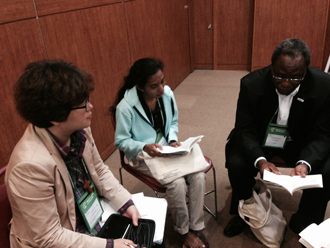
Delegates meet for a daily Bible study at the assembly of the World Council of Churches
Every day of the assembly begins with corporate worship, followed by 90 minutes of Bible study. Small groups of 8–10 people focusing on a selected passage of Scripture benefit from the collective wisdom, culture and experience of the individuals present. In my group there is Lana, a Maori, serving in the United Church of Australia. Two theological students are here from Germany and China, while Mishna is from Sri Lanka and Nestor from Brazil. David serves in the United States, while Robert is a Jamaican man serving God in South Africa.
The first passage for study came from the creation narrative in Genesis 2. A divergence of themes emerged from our discussion: the origin of life, the goodness of God, the value of relationships, and the nature of freedom. My takeaway thought came from a Korean pastor serving in Madagascar: Man was not created by God to simply live on the beach but to care for it.
Following the Bible study is a plenary session for the whole assembly. On Friday, November 1, the topic of this session was Christianity in Asia Today. While still a minority, the Church of Jesus Christ is attracting young and old alike with its message of forgiveness and salvation.
Throughout the course of events, greetings from world church leaders--some present and others addressing delegates via satellite--are received. Among these greetings were words from Pope Francis and the Archbishop of Canterbury who, in a similar fashion, challenged delegates to live and work together in Christian unity toward a more just and peaceful world.
Business sessions and formal ecumenical conversations wrestle with tough issues that often bring out diametrically opposed perspectives and heated debates. It becomes obvious that, with some matters, there will not be complete agreement. In fact, it may well turn out that fewer resolutions on such things will be issued than many had hoped for. And one might be forgiven for asking why we had come so far for seemingly so little. But during the final prayers and reflection of the day, we are reminded of the high priestly prayer of Jesus in John 17. We have come to listen and to learn from each other. We have come to be together as part of the body of Christ and to pray that God's will may be done on earth as it is in heaven.
“Reconciliation is the ongoing work of restoring right relationship—with ourselves, Creator, one another and creation,” says Mackenzie Griffin, Indigenous liaison specialist for The Salvation Army in Kelowna, B.C.




 Delegates meet for a daily Bible study at the assembly of the World Council of Churches
 Delegates meet for a daily Bible study at the assembly of the World Council of Churches


Leave a Comment