
I was born in a non-religious Chinese family in British Hong Kong. My father had a strong influence on me, teaching me about the importance of knowledge and honouring my parents in the Confucian sense. He was the eldest son, and he tasked me, his eldest son, to give incense to Grandma every day.
It was common for parents to send children to church-run schools in Hong Kong because they are generally better. At my Catholic school, I had to memorize Bible verses, complete assignments and write exams for religious studies class. A verse that stuck was John 15:13: “Greater love has no one than this: to lay down one’s life for one’s friends.”
With my strong memory for things that I like, I carried my team to victory in an interclass trivia contest on religious topics. The final question and the tie-breaking question were related to hymns praising the Holy Spirit and Jesus as the fountain of life. These all left a great positive impact on me and my forming faith.
When I was 15, my family immigrated to Vancouver. A classmate invited me to a Cantonese-speaking Baptist church, and I started attending. They gave me a Chinese Bible and an Our Daily Bread devotional. I followed the daily schedule and often read the whole chapter of the assigned reading out of a pure heart. I had much joy reading through the passages for the first time, even though I was already familiar with many of the stories. It did not take too long before I received Christ in response to a sermon.
In my early Christian life as a high school student, I made mistakes in evangelism that contributed to a strong sense of guilt, shame and a period of depression. In a nutshell, my desire for romance and pride in following the rules of “no missionary dating” drove me to share my faith with a wrong motive and a wrong focus. But by the grace of God, expressed in Romans 8, I experienced his forgiveness and the situation turned around.
In the decade that followed, I was empowered and equipped to evangelize. While I studied business and computer science at the University of British Columbia, I was active with Power to Change (formerly known as Campus Crusade for Christ). It was during a mission trip to Panama that a colleague mentioned Jonathan Evans, the corps leader at Boundless Vancouver. That was one of my first (indirect) encounters with The Salvation Army.
In April 2017, everything in my life was causing stress—my work in the telecommunications business, my other grandmother’s deteriorating health, my participation in a local theatre, and church. I had nothing to turn to other than God. He responded with one word: artizo, which means “mending” and “equipping” in Greek. Artizo was also the preaching training program that I came across during my undergraduate days, where I received training.
Just as I began pursuing a master of divinity program at Regent College, the local radio station invited me—and my fellow contestants from a past singing competition—to get involved in a clothing drive supporting the Army’s National Recycling Operations. That was my second encounter with The Salvation Army.
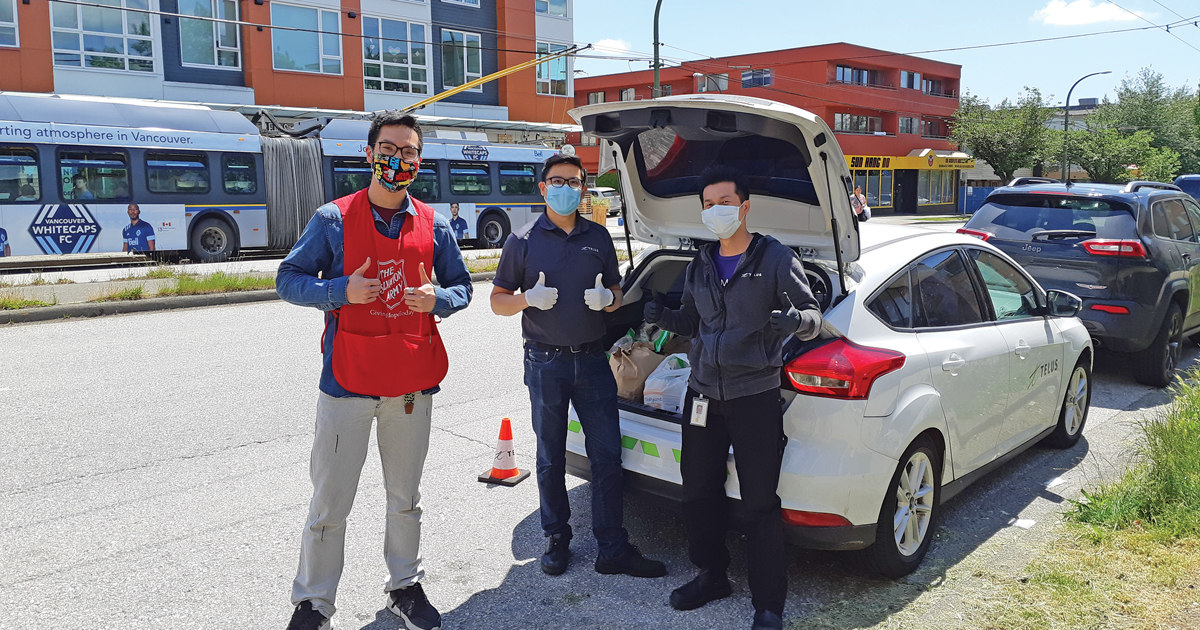
This has been another pivotal year in my life. In January, I was searching for post-M.Div. employment and met a chaplain from The Salvation Army at a networking event. She remembered me from when I was the guest preacher at her church while I was in the Artizo program. Later, after getting to meet Jonathan Evans in person, I was called to lead Boundless Vancouver’s community ministries just as COVID-19 began to pick up. My third encounter with The Salvation Army has been to serve.
From Power to Change, to Artizo, to The Salvation Army, God has been preparing me to do his work: to preach the good news of Jesus, to care for human needs, to steward God-given resources, to be a friend, and to respond to his call any time, anywhere, at any cost, to do anything, all for his glory. I can trust his lead.




God is love